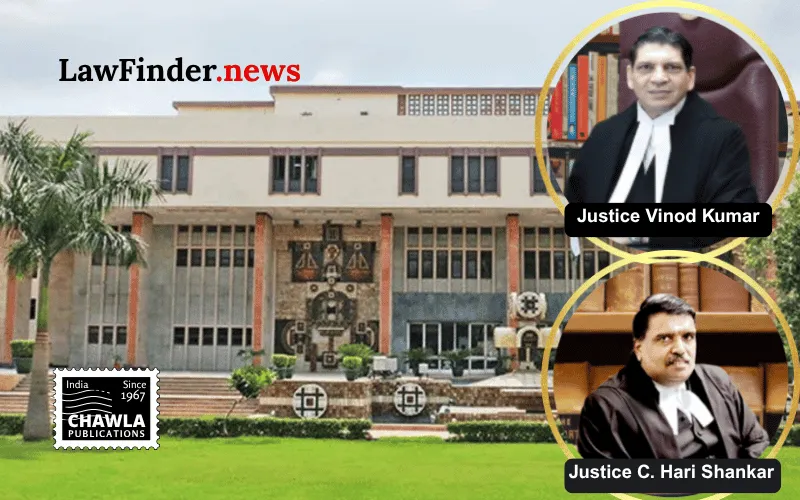
Court emphasizes importance of adhering to specified qualifications for public posts, rejects Tribunal's decision to allow candidates with Master's degrees for Bachelor's degree-required posts.
In a significant ruling, the Delhi High Court has quashed a decision by the Central Administrative Tribunal, thereby denying eligibility to candidates possessing higher academic qualifications for a post that specifically requires a Bachelor's degree. The judgment, delivered by Justices C. Hari Shankar and Vinod Kumar, underscores the imperative of adhering to recruitment rules and statutory qualifications to ensure fair employment opportunities.
The case involved candidates with Master's degrees in Domestic Science/Home Science vying for the position of Domestic Science Teacher (TGT) under the Delhi Subordinate Services Selection Board's advertisement which stipulated a Bachelor's degree in Domestic Science/Home Science as essential. The Tribunal had previously allowed the candidates to be considered eligible, reasoning that a Master's degree should subsume the Bachelor's degree requirement, a decision now overturned by the High Court.
The court meticulously analyzed judicial precedents and statutory provisions, particularly highlighting the Supreme Court's stance in "Jomon K.K. v. Shajimon P," which asserts that higher qualifications do not automatically fulfill the requirement of lower qualifications unless expressly permitted by statutory rules. The judgment also referenced the Supreme Court's decision in "General Manager (HR) v. K. Poovarasan," which emphasizes the need to reserve certain posts for candidates with lower qualifications to ensure equitable employment opportunities.
The High Court pointed out that allowing candidates with higher qualifications to compete for posts meant for specific lower qualifications could monopolize job opportunities, thereby disadvantaging candidates exclusively trained for those posts. The judgment reflects a broader philosophy of safeguarding employment opportunities across varying educational levels, ensuring that all citizens have adequate means of livelihood.
The court also rejected arguments regarding the limited availability of Bachelor's degrees in Domestic Science/Home Science, stating that educational institutions have the autonomy to design courses based on market demands and educational policies.
The decision is seen as a reinforcement of recruitment policies that prioritize specific qualifications necessary for public service roles, thus maintaining the integrity and intent behind prescribed educational requirements.
Bottom line:-
Candidates possessing higher qualifications than those prescribed for a post cannot be deemed eligible for that post unless explicitly permitted by statutory rules or recruitment policies.
Statutory provision(s): Rule 6 of the Special Rules of 1975, Rule 10(a)(ii) of the Kerala State and Subordinate Services Rules, 1956, various judgments including Jomon K.K. v. Shajimon P, General Manager (HR) v. K. Poovarasan, P.M. Latha v. State of Kerala, and others.
Govt. of NCT of Delhi v. Manu, (Delhi)(DB) : Law Finder Doc id # 2940965