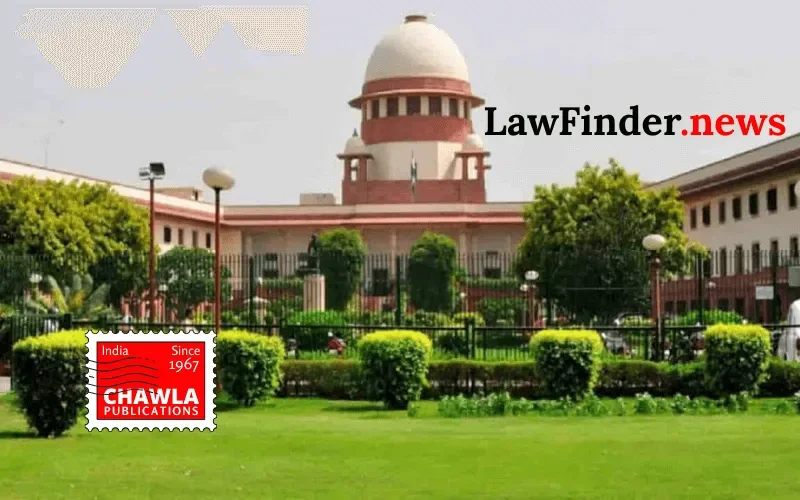
New Delhi, Nov 23 A disposed private case cannot be converted into a public interest litigation where parties from all over the country approach this court and take orders in their matters, the Supreme Court on Monday said as it refused to go into individual violations of civic laws on pan-India basis.
A bench of Justices B V Nagarathna and Sanjeev Sachdeva was hearing a case related to the demolition of unauthorised construction in Tamil Nadu, whose scope was expanded to pan-India level by another bench headed by Justice Ahsanuddin Amanullah to examine violations of civic laws across the country.
The bench said the case was reassigned to it on the instruction of the Chief Justice of India Surya Kant and directed that parties in individual cases can approach the tribunal, high court or other authorities with their grievances.
Recently, the CJI had reassigned two cases earlier heard by the bench headed by Justice Amanullah to different benches after, in a full court meeting last month, it was noted that judges cannot assume jurisdiction over subjects not assigned to them and emphasised strict adherence to the PIL roster.
Justice Nagarathna, while hearing the matter, said that every state has its own Municipal Corporation Act, each Act has come up through its own city heritage and the order passed in one case will not be applicable in another case.
"A private litigation which was disposed of cannot be converted into a public interest litigation where parties from all over the country approach this court and take orders in their private cases," she said.
Justice Nagarathna further added, "What will happen is all private parties who flagrantly violate building function plans will try to move this court. Similarly, orders passed by this court will be used by municipal authorities to run past stay orders or other orders passed by tribunals or high courts and say that the Supreme Court has said to demolish. We do not want to be a party to such a chaos in the legal field."
The bench, which posted the matter for further hearing on January 6, 2027, clarified that it was interested in the larger issue which has been taken up by this court and therefore wants the state and Union Territories to come up with their suggestions as to how they are going to deal with the issue of violation of civic laws.
The top court said it is willing to pass orders to strengthen the hands of the authorities and take any suitable action against violators and unauthorised constructions.
"Some citizens violate and get away with it while the others follow the law and are under compulsion of the law. Why shouldn't everybody be under the compulsion of the law?
"Why are municipal corporations allowing certain sections and persons to breach the building bylaws and go beyond the sanctioned plan… It is hand in glove with those citizens. We are not mincing words, we know what is happening," the top court said.
Justice Nagarathna said the court wants the states to comment and tell how their hands can be strengthened in order to ensure effective compliance with the civic laws.
"We don't want to convert this case of private interest litigation into public interest," it said, and noted that the court finds that there is a practical difficulty in considering this matter on a pan-India basis by including all municipal corporations of capital cities of states and Union Territories because every state and Union Territory has its respective municipal acts and bylaws, which are unique.
"The bylaws and regulations with regard to construction of buildings in the capital cities of all states and Union Territories are distinct. It is neither practical to pass common orders applicable to all states and Union Territories nor is it feasible to go into the issue concerning breach of building bylaws, while putting up construction or carrying out repairs of buildings state wise by this court and further on a case to case basis," it said.
The bench said since this issue is pending before this court, there is a proliferation of litigation before this court by filing of petitions and applications in this case.
"These SLPs, which have already been dismissed, cannot be permitted to be continued as a public interest litigation on a pan-India basis, where orders are being sought in private interest. Hence, the compass of this matter will have to be circumscribed," it said.
The top court said the pending applications before this court seeking relief are disposed of with liberty to the parties to approach the concerned authorities, municipal corporations or municipalities, tribunals or the high court in the respective states for seeking appropriate directions in respect to their individual cases.
"A city is a shared civic space, not really an aggregation of individual property and settlements. It is sustained by multiple rules and regulations including construction or building bylaws of each state and municipal corporation.
"The violation of these laws, regulations and bylaws causes immense damage to the city's civic infrastructure including its roads, drainage and traffic capacity," it said.
Urging citizens to abide by the fundamental duties, the bench said it is disturbing to note the flagrant violations of civic laws throughout the country.
"The Constitution of India provides for participation in a common civic enterprise. Our cities in turn demand the same from citizens, namely the private ambition must remain within public limits," it added.