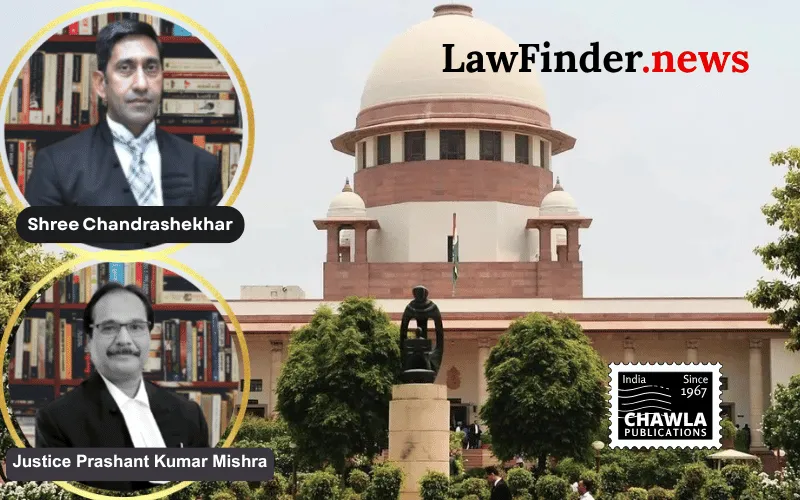
Supreme Court Upholds Dismissal of Election Petition for Not Being Personally Presented by Petitioner
The Supreme Court has dismissed a special leave petition challenging the rejection of an election petition, holding that an election petition under Section 81(1) of the Representation of the People Act, 1951 must be presented by the petitioner himself and that non-compliance with this mandatory requirement attracts dismissal under Section 86(1).
A bench of Justice Prashant Kumar Mishra and Justice Shree Chandrashekhar upheld the Madras High Court’s decision to throw out the election petition filed by V. Pon. Paneerselvam, who had sought to challenge the election of S. Regupathy from the 181-Thirumayam Assembly Constituency in the 2026 Tamil Nadu Legislative Assembly elections.
The petitioner had alleged that the returned candidate’s election was liable to be declared void on grounds including corrupt practice under Section 123(2) of the Act and defects in the affidavit filed in Form 26. However, the High Court had dismissed the petition at the threshold after finding that it was presented by counsel and not by the petitioner in person, as required by Rule 7 of the Madras High Court Election Petitions Rules, 1967.
Before the Supreme Court, the petitioner argued that he had in fact personally presented the petition and relied on materials such as a CISF entry pass, a security deposit receipt, and CCTV footage. The Court, however, found that these materials only proved his presence in the High Court premises and did not establish that he personally presented the election petition before the Registry. The security deposit receipt was also issued in the name of counsel, which weakened the petitioner’s case.
The Court emphasized that election law is a special and self-contained code, and the requirements under Section 81 are strict and mandatory. Referring to earlier decisions including G.V. Sreerama Reddy, Hukumdev Narain Yadav, Jamal Uddin Ahmad, and Dr. Vijay Laxmi Sadho, the bench held that the expression “by” in Section 81(1) is significant and means that the petition must be presented by the election petitioner himself. The Court said this requirement is not a mere procedural formality but goes to the maintainability of the petition.
The bench also upheld the validity of Rule 7 of the Madras High Court Election Petitions Rules, 1967, observing that High Courts are competent to frame rules regulating the ministerial and administrative aspects of receiving election petitions, so long as such rules do not conflict with the statute.
Rejecting the plea for substantial compliance, the Court noted that the petitioner had not even pleaded that he was present with his counsel at the time of presentation, unlike in cases where substantial compliance had been accepted. Since the petition did not satisfy the mandatory requirement of Section 81(1), the Court held that dismissal under Section 86(1) was justified.
Accordingly, the Special Leave Petition was dismissed as without merit.
Statutory provision(s): Representation of the People Act, 1951 Sections 80, 80A, 81(1), 81(3), 82, 83, 86(1), 100(1)(b), 100(1)(d)(i), 100(1)(d)(iv), 101, 117, 123(2)
V. Pon. Paneerselvam v. S. Regupathy, (SC) : Law Finder Doc id # 2992563