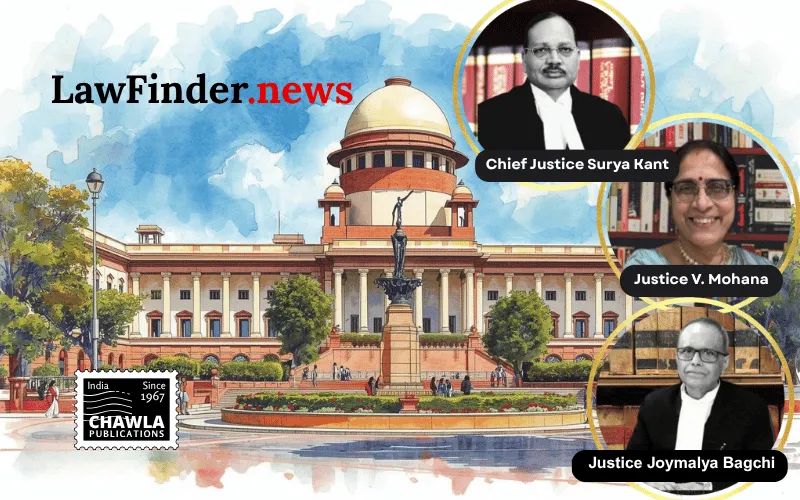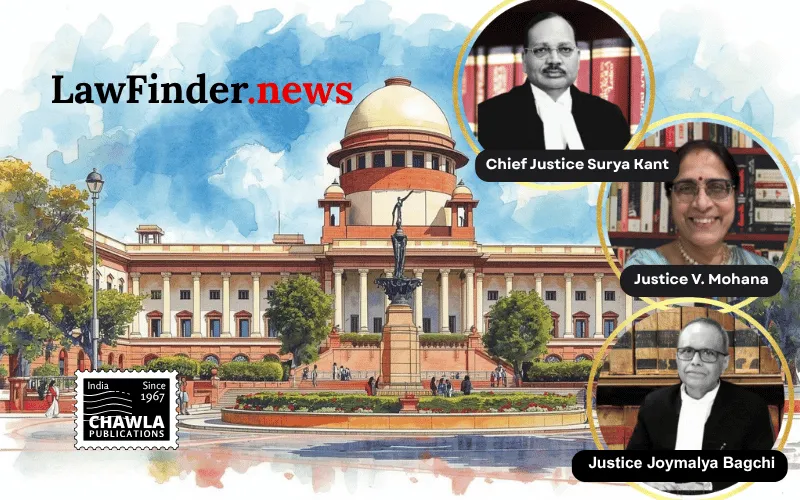
New Delhi, Oct 8 The Supreme Court on Thursday said the rules for appointment of Jharkhand director general of police are in conflict with its earlier decision in the Prakash Singh case and sought the response of senior IPS officer Tadasha Mishra, who was appointed as state police chief a day before her retirement.
A bench of Chief Justice Surya Kant and justices Joymalya Bagchi and V Mohana was told by senior advocate Kapil Sibal, who was appearing for Jharkhand that the state will revisit the rules.
The bench said it is giving an opportunity to Mishra to file her response as she will be affected if the rules are set aside.
"The provision prima facie seems to be directly in the teeth of law laid down in Prakash Singh case (verdict). In the event of the rule being annulled, appointment of Tadasha Mishra, DGP of Jharkhand, would be required to be set aside. We therefore deem it appropriate to accord her the opportunity to be heard," the bench said.
Under the landmark Prakash Singh judgement, an officer must have at least six months of residual service to be considered for the post of DGP to ensure stability and merit.
The bench also asked the Jharkhand government to issue notice to Mishra so that she can appear and assist the court.
"Meanwhile, the state may revisit the offending rule. Post after one week. Alternatively, the State shall be at liberty to file counter affidavit, if any," it added.
The bench asked senior advocate Raju Ramachandran, who has been appointed as amicus curiae in the case to assist the court on validity of the rules formulated by Jharkhand with respect to appointment of DGP.
It added that Ramachandran should look into statutes or regulations and consequential appointments made by other states also and the UPSC will assist the amicus in this regard.
CJI Kant said that any appointment made in contradiction to the decision of the apex court, then it has to go.
Sibal said that as far as Mishra was concerned, he would like to defend her appointment as she is an extraordinary officer but as far as the rules are concerned, the state would revisit them.
The Centre has moved the top court specifically challenging the "Selection and Appointment of Director General and Inspector General of Police, Jharkhand (Head of the Police Force) Regulation, 2025", notified by the state government on January 8, 2025.
Under the regulation, a nomination committee was constituted for the selection of the DGP and it also originally prescribed at least six months of residual service for an officer to be eligible for appointment and provided for a panel of three to five officers.
Solicitor General Tushar Mehta, appearing for the Centre, said that the Centre has repeatedly told the Jharkhand government that its rules were in the teeth of the Supreme Court's Prakash Singh judgement and cannot be sustained.
He said that if any other state has brought such rules, irrespective of the party in power, then it must go.
At the outset, Sibal objected to the submissions of the Centre and said why the Union has only challenged Jharkhand Rules when there are other states having similar rules?
He said the other states have worse rules and pointed that in West Bengal, the officer was appointed as DGP, when he had only six months left for superannuation and the Centre has granted him extension of service.
Mehta countered the allegations of Sibal and said the Union does not pick and choose States and if there are such laws in other states, they must also go.
The Centre in its contempt plea against the State had alleged that the Jharkhand government was in contempt for violating the apex court directions given in the Prakash Singh judgement on appointment of DGP.
It was alleged the Jharkhand government appointed Mishra as DGP on December 30, 2025, a day before her retirement, in violation of the direction that an officer must have at least six months of residual service to be considered for the post of state police chief to ensure stability and merit.
The Centre's plea filed on July 16 urged the top court to declare the appointments of DGP made in Jharkhand under the Regulation of "Selection and Appointment of Director General and Inspector General of Police, Jharkhand (Head of Police) Regulation, 2025" as illegal.
On December 29, 2025, the state amended the regulation, and on December 30 appointed Mishra as DGP despite her scheduled retirement the next day.
The Centre said that the appointment effectively enabled an officer due to retire immediately thereafter to receive a two-year tenure, contrary to the procedure laid down by the Supreme Court.
The plea also referred to the earlier appointment of Anurag Kumar Gupta as DGP on February 2, 2025.
According to the application, Gupta had only about three months of service remaining at the time of his appointment, although he was given a two-year tenure.
By appointing Mishra as DGP 24 hours before her retirement, the state effectively granted her a two-year extension.
The 2006 apex court verdict and subsequent directions in the Prakash Singh case had said the DGP of a state shall be "selected by the state government from amongst the three senior-most officers of the department, who have been empanelled for promotion to that rank by the UPSC on the basis of their length of service, very good record and range of experience for heading the police force".
And, once a person has been selected for the job, they should have a minimum tenure of at least two years irrespective of the date of superannuation, it had said.