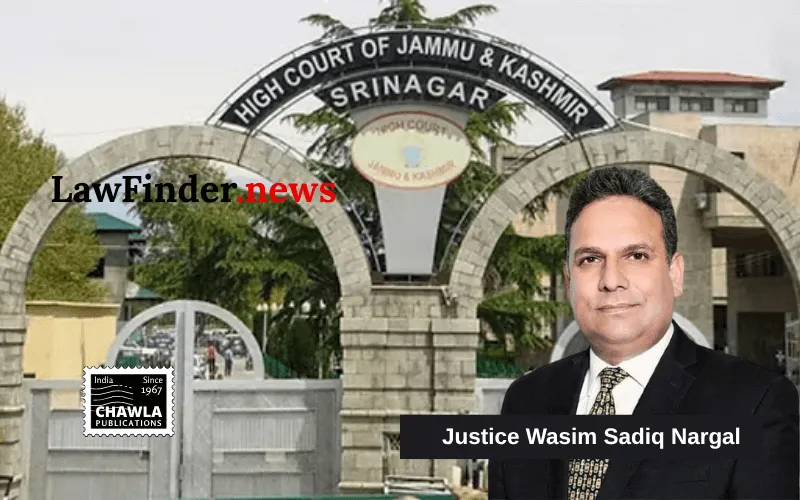
Petitioner Faces Exemplary Costs for Suppressing Material Facts and Abusing Writ Jurisdiction
In a significant judgment, the Jammu & Kashmir and Ladakh High Court dismissed a writ petition filed by Ali Haider Shah, seeking issuance of a Scheduled Tribe Certificate (Central Format). The petitioner had approached the High Court under Article 226 of the Constitution of India, bypassing the statutory remedies available under the Jammu and Kashmir Reservation Act, 2004. The Court, presided by Justice Wasim Sadiq Nargal, found that the petitioner failed to exhaust the statutory remedies of appeal and revision before invoking the writ jurisdiction.
The petitioner, Ali Haider Shah, applied for the Scheduled Tribe Certificate as a member of the Pahari Ethnic Group, following its inclusion in the Scheduled Tribe category pursuant to S.O. 176 dated 15.03.2024. Despite being issued a Scheduled Tribe Certificate (UT Format) earlier, the petitioner's application for a Central Format certificate was rejected by the competent authority based on a report indicating his ineligibility due to residence in District Reasi.
Justice Nargal highlighted that the petitioner did not establish any exceptional circumstances such as violation of fundamental rights or principles of natural justice that would justify bypassing the statutory remedies. The petitioner also suppressed material facts and challenged only the forwarding emails without addressing the substantive orders, leading to the impression that the competent authority recalled the certificate without jurisdiction.
The judgment emphasized that the petitioner must approach the court with clean hands, disclosing all material facts. The selective challenge by the petitioner amounted to an abuse of the process of law. Consequently, the Court imposed exemplary costs of Rs. 10,000 on the petitioner for misleading conduct and suppression of facts.
The Court reiterated that the writ jurisdiction under Article 226 is discretionary and should not be invoked when an effective statutory remedy is available. It advised the petitioner to utilize the appellate and revisional mechanisms provided by the Jammu and Kashmir Reservation Act, 2004, for grievance redressal.
The High Court's decision underscores the importance of exhausting statutory remedies and approaching the court with transparency and honesty. The judgment serves as a reminder to litigants of their obligation to disclose all relevant information when seeking judicial intervention.
Bottom line:-
Writ jurisdiction under Article 226 of the Constitution should not be invoked bypassing statutory remedies unless there are exceptional circumstances such as violation of fundamental rights, lack of jurisdiction, or breach of principles of natural justice. A petitioner must approach the court with clean hands, disclose all material facts, and not abuse the process of law.
Statutory provision(s): Article 226 of the Constitution of India, Jammu and Kashmir Reservation Act, 2004 (Sections 16, 17, and 18)
Ali Haider Shah v. Union Territory of J&K, (J&K and Ladakh) : Law Finder Doc id # 2941899