Court affirms 120-day statutory limit for filing written statements under amended Order V and VIII CPC, but permits exceptions in exceptional circumstances with cost imposition
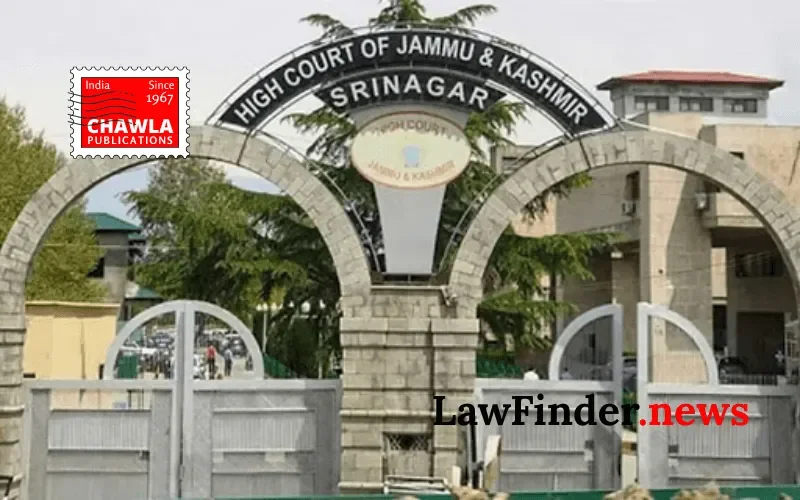
In a landmark judgment dated September 28, 2026, the Division Bench of the Jammu & Kashmir and Ladakh High Court, comprising Justices Rajnesh Oswal and Sanjay Dhar, upheld the constitutional validity of the amended provisions of Order V and Order VIII of the Code of Civil Procedure, 1908 (CPC), as applicable to the Union Territories of Jammu & Kashmir and Ladakh. The amendments, introduced through Notification S.O. 1123(E) dated March 18, 2020, impose a strict statutory timeline of 120 days for defendants to file written statements in civil suits. Failure to comply results in automatic forfeiture of the right to file such a statement, with courts barred from entertaining late submissions.
The petitioners, led by Anoop Dutta and others, had challenged the amendments primarily on grounds that:
- The amendments applied beyond commercial disputes to ordinary civil suits without valid justification.
- The Central Government lacked authority under Section 96 of the Jammu and Kashmir Reorganization Act, 2019, to introduce substantive changes via executive notification.
- The amendments unjustly ousted judicial discretion to extend timelines, thereby violating fundamental rights, including access to justice under Articles 14 and 21 of the Indian Constitution.
- The rigid timelines ignored practical difficulties faced by litigants in the mountainous and remote terrain of the Union Territories.
The court carefully examined the legislative history, noting that identical provisions had existed in the erstwhile Jammu & Kashmir Code of Civil Procedure, Samvat 1977, following the Jammu and Kashmir Code of Civil Procedure (Amendment) Act, 2018. The 2020 notification harmonized the Central CPC with the procedural laws historically in force, thereby maintaining legislative continuity rather than creating a novel regime.
Key findings of the court include:
1. Validity of Executive Power: The Central Government acted within its statutory authority under Section 96 of the Jammu and Kashmir Reorganization Act, 2019, which empowers it to make adaptations and modifications, including repeals or amendments, to laws made before the appointed day to facilitate their application in the Union Territories. The court distinguished this from a similar case in Telangana, emphasizing that the amendments in J&K and Ladakh aligned with pre-existing laws rather than introducing new substantive changes de novo.
2. Applicability to Ordinary Civil Suits: The amendments are applicable to all civil suits, not limited to commercial disputes. While the Commercial Courts Act, 2015 governs high-value commercial litigation with similar timelines, the amendments for J&K and Ladakh extend the procedural regime uniformly to ordinary civil litigation as well.
3. Nature of the Amendments - Mandatory or Directory?: The court held that unlike earlier provisions where timelines were directory with judicial discretion to extend, the amended provisions are mandatory. The 120-day limit is a hard deadline beyond which the defendant's right to file a written statement is forfeited, and courts cannot entertain such statements.
4. Balancing Speedy Justice with Substantive Rights: Acknowledging the principle that procedural laws are the handmaid, not the mistress, of justice, the court recognized that unyielding application of the timeline could lead to injustice, especially in the Union Territories where litigants face unique challenges such as remote geography, natural calamities, serious illness, or delays in obtaining critical public documents. The court emphasized the doctrine of lex non cogit ad impossibilia (law does not compel the impossible).
5. Judicial Discretion in Exceptional Circumstances: While the statutory bar is generally absolute, the court carved out a narrow exception allowing courts to relax the 120-day deadline in "exceptionally hard cases" where compliance was impossible due to reasons beyond the defendant's control. Examples include severe medical conditions, natural disasters, administrative delays, or bona fide attempts at amicable settlement encouraged by the court under Section 89 CPC. Such discretion must be exercised sparingly and cautiously, with the defendant bearing the heavy burden to prove impossibility. Courts must also impose adequate costs on the defendant when permitting such extensions.
6. Consistency with Existing Statutes and Fundamental Rights: The court balanced the legislative intent to curb delays with the constitutional mandate of access to justice under Articles 14 and 21. It noted relevant Supreme Court precedents that procedural technicalities should not defeat substantive rights and that the right to defend oneself is fundamental.
7. Direction for Future Cases: The court directed individual petitions to be listed before Single Judges for further adjudication consistent with this judgment. It emphasized that the amended provisions are constitutionally valid but must be read down to avoid procedural injustice.
The judgment brings clarity to the procedural framework governing civil litigation in Jammu & Kashmir and Ladakh, affirming the government's authority to impose strict timelines while preserving courts' inherent jurisdiction to prevent miscarriage of justice in truly exceptional cases.
Bottom Line:
The amended provisions of Order V and VIII of the Code of Civil Procedure, 1908, applicable to the Union Territories of Jammu & Kashmir and Ladakh, are constitutionally valid. The statutory period of 120 days for filing a written statement is mandatory but can be relaxed in exceptional and unavoidable circumstances where compliance was impossible due to reasons beyond the defendant's control.
Statutory provision(s):
Code of Civil Procedure, 1908 - Order V Rule 1, Order VIII Rules 1 and 10; Jammu and Kashmir Reorganization Act, 2019 - Section 96; Jammu and Kashmir Code of Civil Procedure (Amendment) Act, 2018; Jammu and Kashmir Commercial Courts Act, 2018; Indian Contract Act, 1872 - Section 56; Limitation Act, 1963 - Section 5; Constitution of India - Articles 14 and 21