Supreme Court Declines Clarification Plea on NI Act Ruling, Says Maharashtra Unlicensed Money-Lending Issue Must Be Decided Case by Case
The Supreme Court has declined to issue a clarification on its earlier judgment in M/s. Mansi Finance (Chennai) Ltd. v. M. Lalitha & Others, holding that the question whether a cheque dishonour case under Section 138 of the Negotiable Instruments Act can proceed on the basis of loans advanced by unlicensed money lenders in Maharashtra must be decided by the court concerned on the facts of each case.
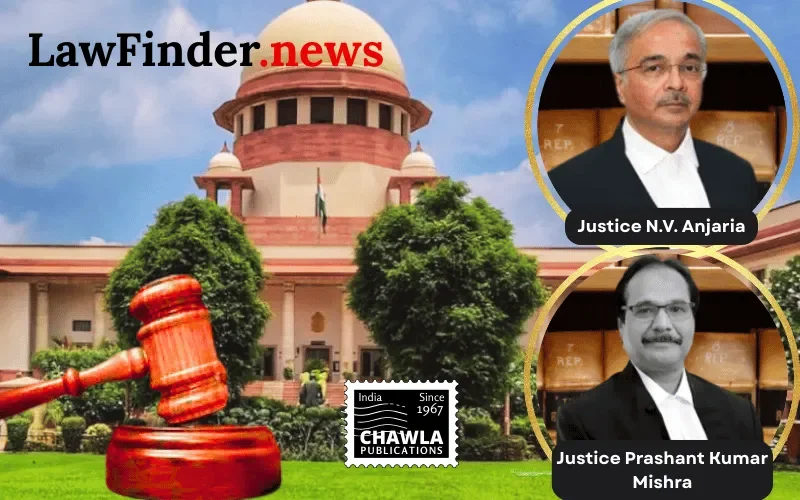
A Bench of Justices Prashant Kumar Mishra and N.V. Anjaria passed the order on October 29, 2026, while disposing of a miscellaneous application filed by Vyomesh Mahipatray Shah.
The applicant had sought clarification that the Supreme Court’s earlier judgment dated May 26, 2026, should not be treated as applicable to prosecutions under Section 138 of the Negotiable Instruments Act in Maharashtra where money was allegedly advanced at interest by an unlicensed money lender against promissory notes.
The plea was based on the distinction between the Tamil Nadu Money-lenders Act, 1957 and the Maharashtra Money-Lending (Regulation) Act, 2014. The applicant argued that while Tamil Nadu law excludes certain advances made on negotiable instruments, the Maharashtra law specifically includes advances made on promissory notes within the definition of “loan”. Therefore, in Maharashtra, such transactions by an unlicensed money lender are prohibited and the resulting debt is not legally enforceable.
The Supreme Court accepted that there is a significant statutory difference between the two state laws. It observed that under Section 2(13)(j) of the Maharashtra Act, an advance on a negotiable instrument is excluded from the definition of loan, but this exclusion does not apply to promissory notes. As a result, a loan advanced at interest against a promissory note in Maharashtra would fall within the regulatory framework of the Maharashtra Act.
The Bench further noted that under Section 4 of the Maharashtra Act, such money lending without a licence is prohibited, and under Section 13, such a loan is not enforceable. Consequently, the Court said that, unlike in Tamil Nadu, such debt in Maharashtra may not qualify as a “legally enforceable debt” for the purposes of the explanation to Section 138 of the Negotiable Instruments Act.
The Court also referred to its earlier order dated April 6, 2026, in another matter, where it had observed that proceedings initiated by private money lenders should be “nipped in the bud”, whether civil or criminal, unless the lender produces a valid licence at the threshold or shows that the money was not advanced at interest.
However, despite these observations, the Bench made it clear that no formal clarification of the May 26 judgment was necessary. It reasoned that the earlier ruling had not examined the provisions of either the Tamil Nadu Money-lenders Act, 1957 or the Maharashtra Money-Lending (Regulation) Act, 2014. That judgment had primarily dealt with the issue of vicarious liability under Sections 138 and 141 of the Negotiable Instruments Act and the sufficiency of allegations against accused persons in a cheque dishonour complaint.
Since the earlier judgment did not decide the enforceability of loans under the Maharashtra money-lending law, the Court held that the issue remains open and must be considered independently by the trial court or any superior court where such a plea is raised.
The Bench said that if a party contends that a loan advanced by an unlicensed money lender in Maharashtra on the strength of a promissory note is barred by statute and therefore cannot be treated as a legally enforceable debt, that contention must be examined on its own merits in the pending proceedings.
With these observations, the Supreme Court disposed of the clarification application, while expressly leaving it open to the parties to raise all such legal objections before the appropriate court.
The ruling is significant for cheque dishonour litigation in Maharashtra, as it underscores that the maintainability of proceedings under Section 138 of the Negotiable Instruments Act may depend on compliance with state money-lending laws where the underlying transaction involves an unlicensed lender and a promissory note.
Bottom Line:
Clarification sought regarding applicability of earlier Supreme Court judgment to prosecutions under Section 138 NI Act involving unlicensed money lending in Maharashtra - Held, earlier judgment had not considered either the Tamil Nadu Money-lenders Act, 1957 or the Maharashtra Money-Lending (Regulation) Act, 2014 - Therefore, no clarification was required - Issue whether debt arising out of loan advanced on promissory note by unlicensed money lender in Maharashtra is legally enforceable has to be decided by concerned court on its own merits.
Statutory provision(s): Section 138, Section 141 of the Negotiable Instruments Act, 1881; Section 2(13)(j), Section 4, Section 13 of the Maharashtra Money-Lending (Regulation) Act, 2014; Tamil Nadu Money-lenders Act, 1957
M/s. Mansi Finance (Chennai) Ltd. v. M. Lalitha, (SC) : Law Finder Doc id # 3005904