Supreme Court Discharges Man in Kerala Case, Says Failed Consensual Relationship Cannot Be Retrospectively Treated as Rape, Court sets aside Kerala High Court and trial court orders, holds no prima facie case under IPC Sections 376(2)(n), 420, 493, 494 and 495
The Supreme Court has discharged Santhosh Kumar N.P. in a criminal case arising from Kerala, ruling that a long-term consensual relationship between two adults cannot later be criminalised as rape merely because the relationship turned bitter.
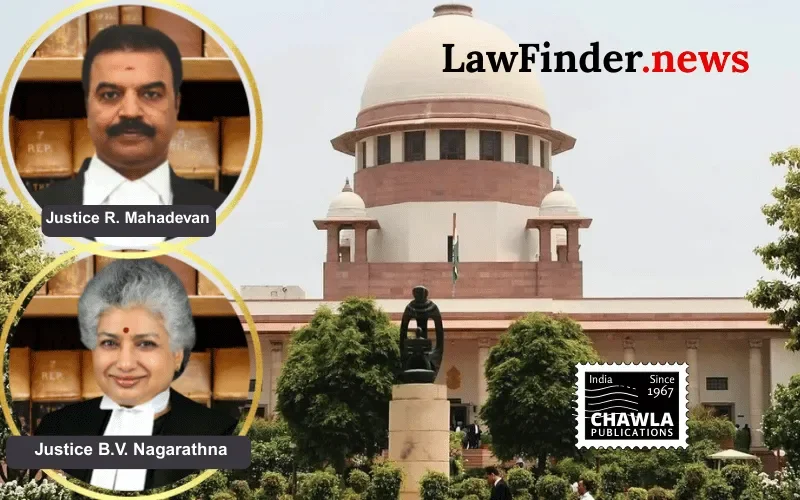
A Bench of Justices B.V. Nagarathna and R. Mahadevan delivered the judgment on October 30, 2026, in criminal appeals challenging a 2025 Kerala High Court order that had refused to discharge the appellant.
The case stemmed from allegations by a woman who claimed that Santhosh Kumar had represented himself as a bachelor, married her in a temple in Mysuru in 1996, and lived with her until 2003. She alleged that she consented to sexual relations believing she was his legally wedded wife, only to later discover that he was already married and had children.
After their relationship ended, the woman first initiated proceedings under the Protection of Women from Domestic Violence Act in 2008. Those proceedings were dismissed. She later filed private complaints alleging offences under Sections 376, 420, 493, 494 and 495 of the Indian Penal Code, leading to registration of an FIR and a sessions case. The trial court rejected the man’s discharge plea, and the Kerala High Court upheld that decision, finding a prima facie case.
The Supreme Court, however, took a different view. It examined the scope of discharge under Section 227 of the Code of Criminal Procedure and reiterated that courts must assess whether the material on record discloses grave suspicion or only weak and improbable allegations. The Bench said a court at the discharge stage is not expected to act as a “post office” for the prosecution, though it also cannot conduct a full trial.
Applying that test, the Court found that the essential ingredients of all the alleged offences were missing.
On the rape charge under Section 376(2)(n) IPC, the Court noted that the complainant had admittedly come to know within a few months of cohabitation that the appellant was already married. Despite this, she continued to live with him for several years. In these circumstances, the Court held that it was not believable that her consent for the entire relationship was based solely on a false belief of lawful marriage.
The Bench said the material on record showed a consensual relationship between two adults rather than repeated sexual assault. It warned against a growing tendency to convert failed intimate relationships into rape prosecutions after the relationship breaks down. The Court stressed that while genuine rape cases must be prosecuted vigorously, criminal law cannot be used as a tool of vengeance or to settle personal scores after emotional fallout.
The Court also rejected the cheating charge under Section 420 IPC, holding that the offence requires dishonest inducement to deliver property or to make, alter or destroy a valuable security. Even if deception regarding marital status were assumed, there was no allegation that the complainant had parted with property or altered any valuable security.
As for Sections 493, 494 and 495 IPC, the Court held that the materials did not prima facie establish a valid marriage in the eyes of law. The alleged temple ceremony, IVF records signed by the appellant as “husband”, a joint savings account and other documents only pointed to a long-standing domestic or personal relationship, not a legally valid marriage. The complainant’s continued cohabitation even after learning of the appellant’s earlier marriage also ruled out the claim that she was living with him under a genuine belief that she was his lawful wife.
The Bench observed that adult individuals may make choices in relationships that later lead to painful consequences, but such outcomes do not automatically amount to criminal offences. It underlined that criminal law should not be “weaponised” in matters that are essentially personal.
Finding that none of the offences alleged against the appellant was even prima facie made out, the Supreme Court held that continuation of the prosecution would amount to abuse of process. It therefore set aside the Kerala High Court’s order as well as the trial court’s order refusing discharge, and allowed the appellant’s discharge application.
The ruling is likely to be significant in cases involving allegations arising out of broken relationships, particularly where courts are called upon to distinguish between genuine deception vitiating consent and consensual adult relationships that later collapse.
Bottom Line:
Where materials on record do not disclose even a prima facie case and essential ingredients of offences under Sections 376(2)(n), 420, 493, 494 and 495 IPC are absent - Accused is entitled to discharge - Consensual long-term relationship cannot be retrospectively criminalised as rape merely because relationship later turned sour.
Statutory provision(s): Section 227 CrPC, Section 156(3) CrPC, Section 482 CrPC, Sections 376, 376(2)(n), 420, 493, 494, 495, 30 IPC, Section 12(1) Protection of Women from Domestic Violence Act, 2005