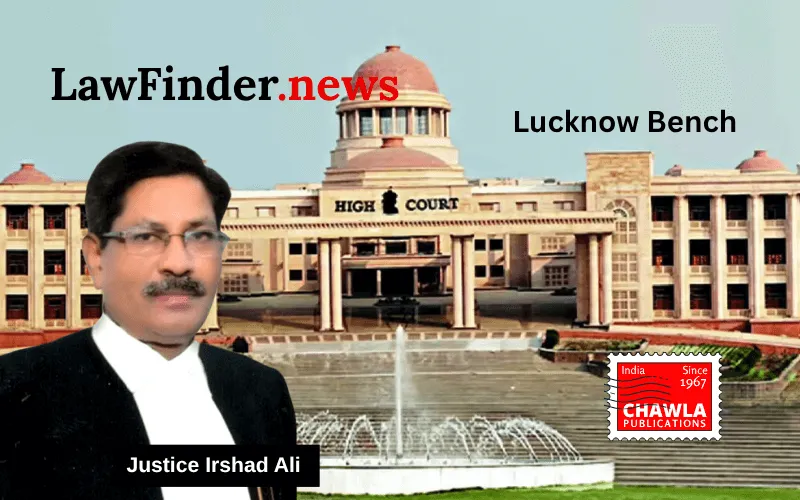
Lucknow, Aug 21 The Lucknow bench of the Allahabad High Court on Friday quashed the termination of over two dozen general category junior engineers recruited by the Uttar Pradesh Jal Nigam in 2013, holding that innocent employees cannot be made to suffer for mistakes made by authorities during the recruitment process.
Justice Irshad Ali, while deciding separate petitions filed by junior engineer Rakesh Pratap Singh and 25 other junior engineers, said that the employees had been appointed by the competent authority against sanctioned posts through a regular selection process and there was no allegation of fraud, misrepresentation or manipulation against them.
The court said that implementation of the reservation policy was mandatory, but the authorities could not adopt a procedure contrary to law and the original selection process in the name of correcting reservation-related irregularities.
"There can be no dispute with the proposition that statutory reservation is required to be faithfully implemented. However, the implementation of reservation must itself be in accordance with the statutory scheme," observed the bench .
The bench also quashed the January 28, 2014 order of the State Backward Classes Commission, holding that it had been passed without jurisdiction.
It said that subsequent administrative action based on an order lacking legal foundation could not be independently sustained.
The case relates to Jal Nigam's recruitment of junior engineers against 470 posts in 2013. The selection was initially conducted category-wise.
Subsequently, objections were raised regarding the selection of some candidates belonging to reserved categories. On January 7, 2014, the Uttar Pradesh Jal Nigam's managing director constituted a three-member committee to examine the alleged irregularities.
The petitioners' counsel senior advocate Upendra Nath Mishra pleaded that the committee, in its report dated January 15, 2014, recommended that additional eligible reserved-category candidates who had been left out be accommodated against 469 vacancies available in the second phase. It also specifically recommended that no general category candidate already selected should be removed from service.
The authorities accepted the recommendation to accommodate the additional reserved-category candidates. Subsequently, 136 additional SC/OBC candidates were appointed, taking the total number of appointments to 543 against the original 470 posts. They were accommodated against available vacancies, added Mishra .
However, on December 2, 2014, the services of 73 general category junior engineers, including Rakesh Pratap Singh, were terminated. The employees approached the high court, which, on December 18, 2014, quashed the termination orders and directed the Uttar Pradesh Jal Nigam to reconsider the matter.
In its latest judgment, the court noted that the December 18, 2014 order had not been challenged before a higher court and was therefore binding on the Jal Nigam. Despite this, the authorities proceeded in a manner contrary to the earlier judicial directions.
The court also criticised the manner in which the subsequent proceedings were conducted. It noted that the show-cause notice itself indicated that termination had become "inevitable". The petitioners had raised several important objections regarding the category-wise selection process, applicability of the reservation provisions, jurisdiction of the Backward Classes Commission, availability of vacancies and the earlier high court order.
The court held that a show-cause notice cannot be reduced to a mere formality and the competent authority must meaningfully consider the employee's reply and deal with the material objections raised.
Rejecting the Jal Nigam's contention that termination was the only option, the court said the additional reserved-category candidates could be accommodated against available vacancies, and this had, in fact, been done.
Therefore, removing the already appointed general category employees was not unavoidable, it said.
The court further held that financial difficulties could not validate an order that was without jurisdiction, arbitrary or contrary to statutory provisions and binding judicial directions.
Quashing the May 14, 2015 termination orders, the court directed that the petitioners be permitted to continue in service. They will also be entitled to continuity of service from their original date of appointment, October 21, 2013.
Rakesh Pratap Singh v. U.P. Jal Nigam, (All)(Lucknow) : Law Finder Doc Id # 2964955