Court Rules that Joint Petition for Divorce Under Special Marriage Act Can Be Entertained in Court Where Either Spouse Resides; Cooling-Off Period Waived in Case of Long Separation
In a significant judgment delivered on September 2, 2026, the Madras High Court (Madurai Bench, Division Bench) clarified the issue of territorial jurisdiction in mutual consent divorce petitions filed under the Special Marriage Act, 1954. The Court held that when spouses jointly present a petition for divorce by mutual consent, the petition can be entertained by the Family Court or District Court within whose local limits either spouse resides. Further, the Court emphasized that objections to territorial jurisdiction can be waived if both parties consent to the jurisdiction of the court.
The appeal arose from the dismissal of a petition filed by A. Prabhu Shankar and his wife in the Family Court at Thanjavur seeking dissolution of their marriage by mutual consent. The Family Court had dismissed the petition on the ground that it lacked territorial jurisdiction, as the marriage was solemnized in Trichy and the wife resided there. The appellants challenged this order, asserting that the Family Court at Thanjavur had jurisdiction since the husband resided there and both parties consented to the venue.
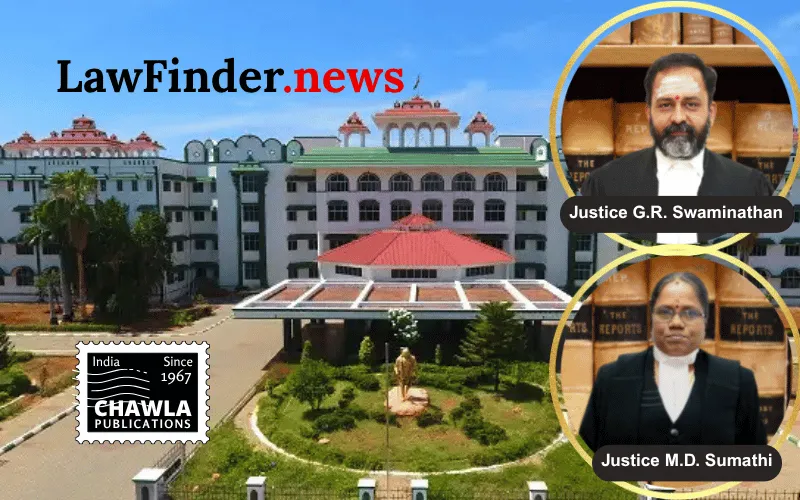
The High Court bench comprising Justices G.R. Swaminathan and M.D. Sumathi heard the appeal and conducted a detailed inquiry. It was noted that the couple had been living separately for over three years and had mutually agreed to dissolve their marriage. The wife, a homemaker residing in Trichy, had no objection to the petition being entertained in Thanjavur, where the husband, a Judicial Officer, was posted.
Referring to Section 31 of the Special Marriage Act, the Court observed that the law allows a petition for divorce to be filed in the district court within whose jurisdiction either the place of marriage, the residence of the respondent, or the last matrimonial residence falls. The Court further pointed out that the statutory provisions also allow the wife to file a petition where she is residing at the time of presentation, thereby providing flexibility in venue choice.
The Court held that the Family Court at Thanjavur could not have dismissed the petition outright for lack of territorial jurisdiction. Instead, as per principles analogous to Order VII Rule 10 of the Code of Civil Procedure (CPC), the petition should have been returned to the parties if jurisdiction was in question, rather than dismissed. However, the Court went beyond procedural technicalities and ruled on the merits, holding that since the husband resided in Thanjavur and the wife consented to the jurisdiction, the objection to territorial jurisdiction was waived.
The judgment also drew upon precedents from various High Courts and the Supreme Court of India, which emphasize the importance of convenience, particularly for the wife, in matrimonial proceedings. The Court underscored that the spirit of the law is to facilitate amicable dissolution of marriage without undue procedural hindrances.
Given that all statutory requirements under Section 28 of the Special Marriage Act were fulfilled-including the parties living separately for more than three years-and there was full consensus, the Court waived the six-month cooling-off period usually mandated in mutual consent divorces. Consequently, the Court set aside the Family Court's dismissal and granted a decree dissolving the marriage by mutual consent.
This judgment reinforces the principle that in matrimonial matters, especially mutual consent divorces, courts must interpret territorial jurisdiction provisions flexibly to uphold the parties' convenience and consent. It also clarifies procedural safeguards regarding dismissal and return of petitions on jurisdictional grounds.
Bottom Line:
Special Marriage Act, 1954 - Joint petition for mutual consent divorce can be presented in the Family Court/District Court within whose local limits either spouse resides - Objection to territorial jurisdiction can be waived.
Statutory provision(s):
Special Marriage Act, 1954 - Sections 28, 31; Code of Civil Procedure, 1908 - Order VII Rule 10; Hindu Marriage Act, 1955 - Section 19 (referred)
A. Prabhu Shankar v. Nil, (Madras)(DB)(Madurai Bench) : Law Finder Doc Id # 2973862