Court says conviction based mainly on dock identification was unsafe as FIR named unknown extremists, no TIP was held, torchlight identification was doubtful, and key medical evidence was not properly proved.
The Patna High Court has set aside the conviction of 13 appellants in a 1996 murder case from Jehanabad district, holding that the prosecution failed to prove their identity and participation beyond reasonable doubt.
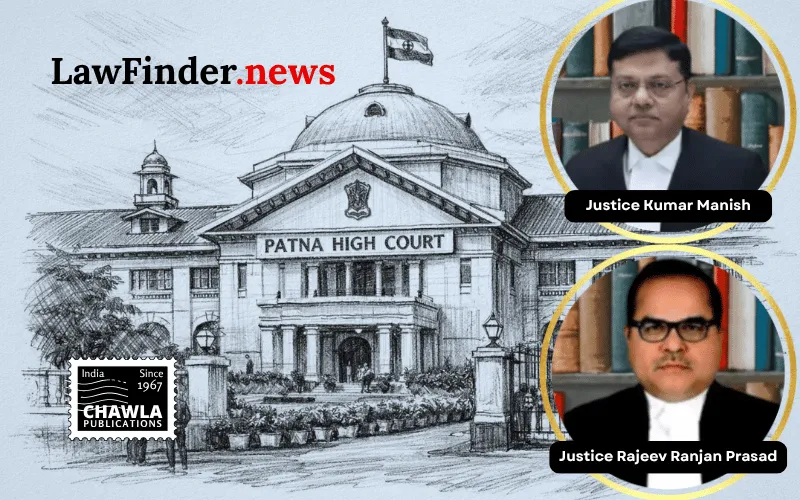
A Division Bench of Justice Rajeev Ranjan Prasad and Justice Kumar Manish allowed the criminal appeals arising out of Sessions Trial Case No. 65 of 1998, which had resulted in conviction under Sections 302/34, 307/34, 148 of the Indian Penal Code and Section 27 of the Arms Act. The trial court had sentenced the convicts to life imprisonment and other concurrent terms for the killing of four persons and injuring another during a late-night attack near an aahar bandh at village Keyal.
According to the prosecution, the informant Shiv Narayan Singh said that 30 to 40 armed persons, allegedly MKSP extremists, attacked a hut where villagers were watching the bandh. Four people died and one injured witness, Pramod Kumar, survived. However, the High Court found that while the occurrence and the homicidal deaths were established, the identity of the accused was not.
The court noted several serious gaps in the prosecution case. The FIR was lodged against unknown persons, and the informant had only said that the assailants could be identified if shown. No Test Identification Parade was conducted, even though the accused were first identified in court after a gap of nearly eight years. The judges held that such dock identification, without prior TIP or other reliable corroboration, had little evidentiary value.
The Bench also found the prosecution’s claim of identification in torchlight unconvincing. Witnesses gave inconsistent versions about who flashed the torch and from which direction. The court observed that if the torch was flashed towards the witnesses, it could have caused partial blindness, making reliable identification difficult in a chaotic night-time mob attack.
The testimony of the injured witness, Pramod Kumar, was accepted only to the extent that he was present and injured during the incident. But the court said his identification of Dhananjay Yadav in court after eight years, without prior TIP, was insufficient to sustain conviction. The court also found that the alleged presence and identification of other accused standing outside the hut was not believable.
The Bench further criticised the investigation as grossly negligent. It pointed out that material exhibits such as torch, blanket, lathi, blood-stained articles and empty cartridges were not properly seized or produced. Seizure lists were not proved, the post-mortem reports of the deceased were not brought on record, and the doctors who conducted the post-mortems were not examined. The court also said incriminating circumstances were not properly put to the accused under Section 313 CrPC.
Holding that the prosecution had failed to establish guilt beyond reasonable doubt, the High Court acquitted the appellants and directed their release forthwith if not wanted in any other case.
In a strong postscript, the court deprecated the indifferent attitude of the investigating agency and ordered the Director General of Police, Bihar to constitute a three-member committee of senior police officers to review the manner of investigation and take appropriate administrative action. The Home Department was also asked to inform the court about its policy for reviewing cases where investigative lapses have been pointed out.
Bottom Line:
Murder trial - Conviction based mainly on dock identification set aside - Where FIR named unknown extremists, no Test Identification Parade was held, source of identification in torchlight was doubtful, postmortem reports were not proved, material exhibits were not seized or produced, and incriminating circumstances were not properly put to accused under Section 313 CrPC, prosecution failed to establish identity of appellants beyond reasonable doubt - Acquittal granted with directions for departmental review of defective investigation.
Statutory provision(s): Sections 302/34 IPC, Section 307/34 IPC, Section 148 IPC, Section 27 Arms Act, Section 9 Evidence Act, Section 313 CrPC, Section 164 CrPC, Section 293 CrPC
Upendra Yadav v. State of Bihar, (Patna)(DB) : Law Finder Doc id # 2996520