Court emphasizes alternative remedy under Section 23 of Rajasthan Entry of Goods into Local Areas Act, 1999, and refuses to entertain writ petition involving disputed factual questions
In a significant ruling dated August 6, 2026, the Rajasthan High Court (Jaipur Bench) dismissed a writ petition filed by M/s Sika India Pvt. Ltd. challenging an assessment order and consequential demand notice issued under the Rajasthan Entry of Goods into Local Areas Act, 1999 ("the Act of 1999"). The petitioner had sought quashing of the assessment order dated December 18, 2018, and refund of the recovered amount totaling Rs. 21,24,470/- on grounds of limitation and procedural irregularity.
The assessment order was passed by the Commercial Taxes Officer, Special Circle XI, Jaipur, demanding entry tax, interest, and penalty relating to the financial year 2015-16. The petitioner contended that the order was barred by limitation under Section 12(6) of the Act of 1999, which requires assessments to be completed within two years from the end of the relevant year. The petitioner also argued that no valid notice was served within the prescribed period.
However, the respondents-The State of Rajasthan and others-contended that the petitioner had an efficacious alternative remedy under Section 23 of the Act of 1999, which provides for appeals against assessment orders before a prescribed appellate authority. They submitted that the petitioner failed to avail the appeal remedy within the statutory 30-day period and instead chose to file the writ petition after nearly two years, without sufficient explanation for the delay.
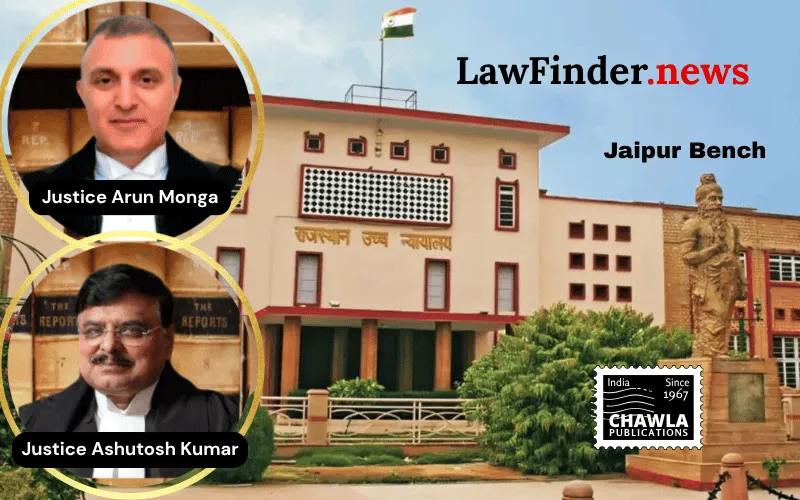
The bench comprising Justice Arun Monga and Justice Ashutosh Kumar held that the writ jurisdiction under Article 226 of the Constitution cannot be exercised when there exists an alternative and equally efficacious remedy of appeal. The court emphasized that disputed questions of fact-such as whether the assessment notice was issued and served within limitation-cannot be adjudicated in writ proceedings, which are summary in nature and do not permit detailed factual inquiry or evidence recording.
The court pointed out that the Act of 1999 is a complete code for adjudication of entry tax disputes, and the appellate authority under Section 23 is vested with wide powers to confirm, reduce, enhance, annul, or set aside the assessment order and direct a fresh assessment. All grounds raised by the petitioner, including the limitation plea, could be effectively examined by the appellate authority.
The court also noted that the petitioner had already deposited the entire disputed amount (Rs. 21,24,470/-) either through attachment of bank accounts or under protest, which satisfies the pre-deposit condition under Section 23(3) of the Act, subject to verification by the appellate authority. It was clarified that no further recovery shall be made during the pendency of appeal if filed timely.
While dismissing the writ petition, the court granted liberty to the petitioner to file an appeal within thirty days from the date of the order, including an application for condonation of delay. The appellate authority was directed to consider such application on its merits, taking into account the time spent before the High Court.
This ruling reiterates the principle that extraordinary writ jurisdiction is not a substitute for statutory appeal mechanisms and underscores the importance of adherence to procedural requirements in tax assessment matters. It also clarifies that courts should refrain from interfering in disputes involving contested factual issues in writ proceedings.
Bottom Line:
Writ petition challenging assessment order under the Rajasthan Entry of Goods into Local Areas Act, 1999, dismissed due to availability of an equally efficacious alternative remedy of appeal under Section 23 of the Act, involving disputed questions of fact not resolvable in writ jurisdiction.
Statutory provision(s):
Rajasthan Entry of Goods into Local Areas Act, 1999 Sections 12, 12(6), 23(1), 23(2), 23(3), 23(5); Rajasthan Goods and Services Tax Act, 2017 Section 174; Constitution of India Article 226