Court Censures State for Failing to Follow NHRC Guidelines on Independent Investigation and Magisterial Inquiry in Police Encounter Death of a Farmer
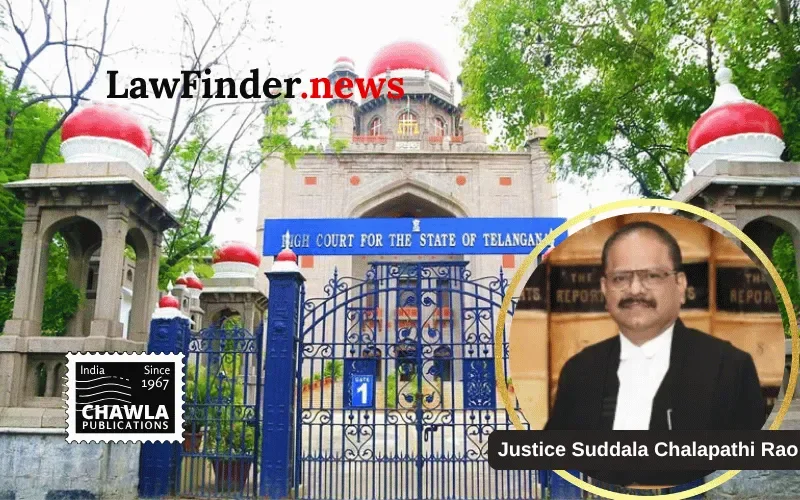
In a significant judgment delivered on November 13, 2026, the Telangana High Court, presided over by Justice Suddala Chalapathi Rao, has directed the State to pay Rs. 2,00,000 as compensation to Ponna Venkatamma for the police encounter death of her husband, Mr. B. Balanarsaiah, in Medak District. The Court held that the State violated the fundamental right to life under Article 21 of the Constitution of India by failing to adhere to the procedural safeguards mandated by law and National Human Rights Commission (NHRC) guidelines.
The incident dates back to December 11, 2001, when Mr. Balanarsaiah, a small farmer from Chetla Thimmayapalli village, was allegedly killed by police personnel in an encounter scenario. The police claimed that Mr. Balanarsaiah was a member of the outlawed People's War Group (PWG) involved in an armed confrontation with the police, which necessitated firing in self-defence. However, the petitioner contended that her husband was innocent and that the police concocted the encounter narrative to justify his death.
The Court carefully examined the facts and found procedural lapses by the police authorities. Notably, the police did not register an FIR against the involved personnel nor conduct an independent investigation by an agency such as the State CID, as required by the NHRC’s 1997 guidelines. Furthermore, the mandatory magisterial inquiry, also stipulated by NHRC, was not conclusively completed or documented.
Referencing landmark Supreme Court judgments including Extra Judicial Execution Victim Families Association v. Union of India (2017), Nilabati Behera v. State of Orissa (1993), and People’s Union for Civil Liberties v. State of Maharashtra (2014), the Court reiterated that the right to life is inviolable and can only be curtailed through a procedure established by law. The Court emphasized that the State’s failure to follow NHRC guidelines and judicially laid down procedures raised serious doubts about the justification of the police action.
While acknowledging the police’s claim of self-defence, the Court observed that such a plea requires cogent and specific material obtained through proper investigation and inquiry, which was not forthcoming in this case. The Court also noted that ordering investigation at this belated stage may not be fruitful given the lapse of over two decades.
Consequently, the Court held the State liable for the unlawful death and directed the payment of compensation within eight weeks to the petitioner and her children. The writ petition was partly allowed with no order as to costs.
This judgment underscores the vital importance of following NHRC guidelines and statutory procedures to uphold constitutional guarantees and human rights in cases of police encounters.
Bottom Line:
Right to Life - Compensation awarded for police encounter death violating Article 21 of the Constitution of India - Failure of State to follow NHRC guidelines, including independent investigation of encounter deaths, amounts to violation of procedural safeguards.
Statutory provision(s): Article 21 of the Constitution of India, Sections 147, 148, 307, 149 IPC, Sections 25(1), 27 of Indian Arms Act, Section 174 Cr.P.C.
Ponna Venkatamma v. Kishen Singh, (Telangana) : Law Finder Doc Id # 3129692