Court rules against landowners' plea challenging 220 KV transmission line erection without acquisition; suspends advocate A. Ushi Reddy for defying Bar Council's suspension order, orders criminal and contempt proceedings.
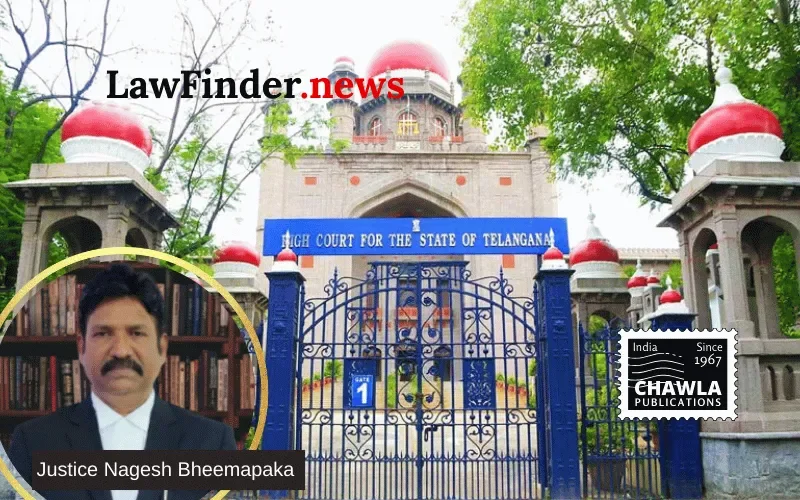
In a significant judgment dated October 16, 2026, the Telangana High Court, presided over by Justice Nagesh Bheemapaka, dismissed a writ petition filed by landowners challenging the erection of 220 KV transmission towers on agricultural land in Bayannagudem Village, R.R. District, without prior land acquisition proceedings. The Court held that the writ jurisdiction under Article 226 of the Constitution of India was not the appropriate forum for such relief and directed the petitioners to approach the competent civil court.
The petitioners claimed ownership and possession of approximately 25 acres across various survey numbers and contended that AP TRANSCO had commenced work on erecting transmission towers without issuing any acquisition notice or conducting land acquisition under applicable laws. They sought judicial intervention to reroute the alignment of two towers which were allegedly located in the middle of their lands.
The respondents, represented by the Government of Andhra Pradesh's Department of Energy and AP TRANSCO, demonstrated that the project was authorized by a government order and sanctioned with administrative approval. The transmission towers were mostly erected before the writ petition was filed, and crucially, the land on which one tower was constructed was shown by revenue records to be owned by a third party, not the petitioners. The Court relied on the Supreme Court precedent in Power Grid Corporation of India v. Century Textiles, which clarified that such matters require resolution through civil courts and not writ petitions.
Beyond the substantive dispute, the Court also dealt with a grave professional misconduct issue involving the erstwhile counsel for the petitioners, Mr. A. Ushi Reddy. The Bar Council of Telangana had suspended Mr. Ushi Reddy from practicing law pending disciplinary proceedings under Section 35 of the Advocates Act, 1961. Despite this suspension, Mr. Ushi Reddy was found to have repeatedly appeared in courts wearing advocate robes, filing vakalatnamas, and acting in the capacity of a lawyer.
The Court categorized his conduct as a "fraud on the court" and "interference with the administration of justice," warranting strict action. It was noted that Mr. Ushi Reddy's suspension had not been stayed or set aside by any competent judicial forum. The Court directed the Registrar (Management) to lodge a criminal complaint against him and the Registry (Judicial) to initiate contempt proceedings. The order clearly stated that until the suspension order is lifted, Mr. Ushi Reddy is barred from practicing law before any court, quasi-judicial, or statutory authority.
The judgment underscores the binding nature of Bar Council orders suspending advocates, emphasizing the statutory authority of the Bar Council under the Advocates Act. It also reaffirms the principle that disputes over land acquisition and infrastructure projects must be resolved by civil courts, not through extraordinary writ jurisdiction.
The High Court directed the Bar Council of Telangana to circulate the order to all bar associations to ensure compliance by legal practitioners within the state.
Bottom Line:
Advocate suspended by the Bar Council for disciplinary reasons cannot appear in any court or authority as an advocate; any such act is considered a fraud on the court and interference with the administration of justice.
Statutory provision(s):
Advocates Act, 1961 Section 5, Section 35; Constitution of India Article 226; Contempt of Courts Act.
Nageshwar Rao Nagi Reddy v. Government of Andhra Pradesh, (Telangana) : Law Finder Doc Id # 3033566