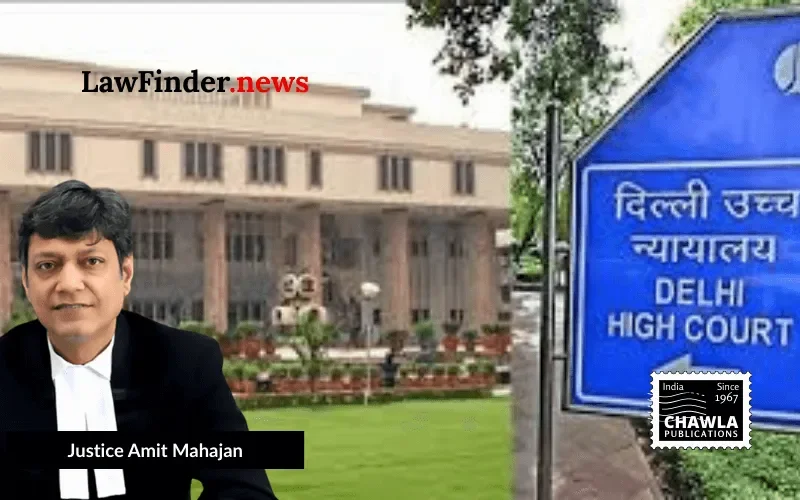
Court Refuses to Reopen Decades-Old Dispute Originating From 1988 Tender, Citing Delay, Laches, and Limitations of Writ Jurisdiction
In a recent judgment delivered on November 5, 2026, the Delhi High Court, presided over by Mr. Amit Mahajan, J., dismissed a writ petition filed by S C Gupta seeking Rs. 10 crores in damages for alleged defamation and harassment arising from statements made during arbitral proceedings. The petitioner, proprietor of M/s Electronic Enterprises, contended that a statement by the Deputy Director General of All India Radio during arbitration wrongly implied that his factory was not inspected in connection with a 1988 tender floated by the Directorate General of Supplies and Disposals (DGS&D).
The petitioner's claim centered on an assertion that the Deputy Director General's testimony before the Sole Arbitrator was incorrect and defamatory, causing mental agony, physical and social harassment. He further sought production of the inspection report from October 1988 to substantiate his claims.
However, the Court underscored that the writ petition was filed nearly seven years after the arbitral award dated December 31, 2019, and almost four decades after the original tender proceedings. The Court emphasized that such unexplained delay and laches disentitle a party from seeking discretionary relief under Article 226 of the Constitution of India.
Critically, the Court observed that the petitioner had participated as the claimant in the arbitral proceedings, had the opportunity to cross-examine the Deputy Director General, and had not challenged the arbitral award itself. The award had already recorded that the material facts stated by the Deputy Director General remained uncontroverted, and it had directed payment of Rs. 1 lakh with interest to the petitioner while rejecting other claims.
The Court held that Article 226 writ jurisdiction is not a suitable forum to reopen or re-litigate settled factual controversies, particularly those involving disputed questions of fact such as the truthfulness or defamatory nature of statements made during arbitration. These issues require thorough factual examination and are better addressed through appropriate remedies, not through extraordinary writs.
In conclusion, the Delhi High Court dismissed the petition, reinforcing the principle that delay and laches can bar relief under writ jurisdiction, especially where longstanding disputes and arbitral awards are involved. The ruling underscores the Court's reluctance to permit collateral attacks on arbitral proceedings and awards through writ petitions years after the fact.
Bottom Line:
Writ jurisdiction under Article 226 cannot be used to revisit or reopen factual controversies already settled in arbitral proceedings, especially after an inordinate delay without justified reasons.
Statutory provision(s):
Constitution of India, Article 226
S C Gupta v. Director General All India Radio, (Delhi) : Law Finder Doc Id # 3023085