Supreme Court Sets Aside Bail, Stay of Conviction for Karnataka Murder Convicts, Says Statutory Disqualification Alone Is No Ground, Top court restores sentences of life convicts in Yogesh Goudar murder case, holds that stay of conviction is an exceptional remedy and criticises High Court for overlooking settled legal principles.
The Supreme Court on 25 November 2026 set aside a Karnataka High Court order that had granted bail by suspending the sentence of several life convicts and had also stayed the conviction of sitting MLA Vinay Rajashekharappa Kulkarni in the murder case of Zilla Panchayat member Yogesh Goudar.
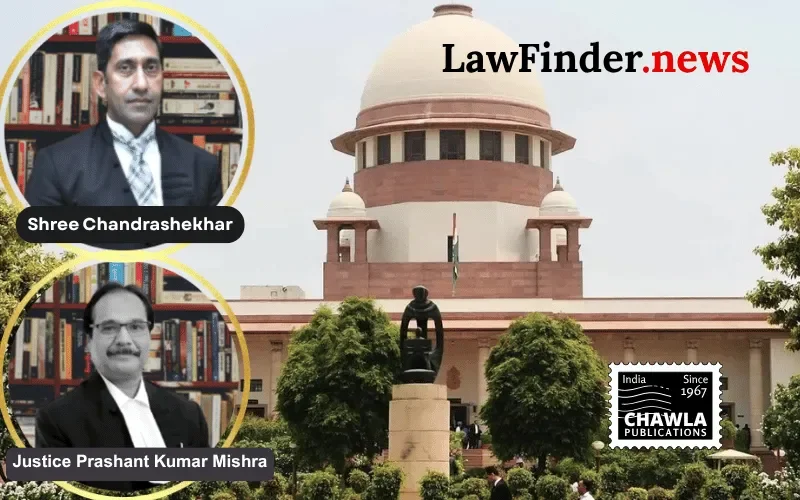
A Bench of Justices Prashant Kumar Mishra and Shree Chandrashekhar held that disqualification under Section 8(3) of the Representation of the People Act, 1951 cannot be the sole or primary basis for staying a conviction. The Court said stay of conviction is an exceptional remedy and can be granted only where the convict demonstrates a “higher threshold” — namely, a palpable and apparent error in the judgment of conviction that strikes at its foundation.
The case arose from the murder of Yogesh Goudar in Dharwad on 15 June 2016. The prosecution alleged that the killing was the result of a criminal conspiracy involving Vinay Rajashekharappa Kulkarni as the mastermind, Chandrashekar Indi alias Chandu Mama as the logistics provider, and others as the assailants. The investigation was initially carried out by the Dharwad police and later taken over by the CBI as further investigation. Several accused were convicted by the trial court in Special C.C. No. 565 of 2021, including Kulkarni, who was convicted for offences under the IPC and was facing disqualification as a sitting MLA.
The High Court had stayed Kulkarni’s conviction on the ground that, without such relief, he would suffer irreversible consequences, including disqualification from the Assembly. It had also suspended the sentences of other convicts, including one Investigating Officer convicted of fabricating evidence.
The Supreme Court, however, found that the High Court’s order did not identify any serious legal error in the conviction judgment. It said the High Court merely recorded rival submissions and relied heavily on the possible disqualification of the MLA, which the apex court described as a statutory consequence and not a valid standalone reason to stay conviction. The Court observed that if that logic were accepted, every convicted legislator could seek automatic stay of conviction, defeating the legislative intent behind disqualification provisions.
On the question of suspension of sentence under Section 389 CrPC, the Court reiterated that appellate courts must not re-appreciate evidence in detail at that stage. It said suspension of sentence in grave offences such as murder requires compelling reasons, and the court must form a prima facie view that the convict has a fair chance of acquittal. Mere pendency of appeal, or the possibility that the appeal may not be heard soon, is not enough.
The Bench also rejected the argument that the approver’s testimony was inherently unreliable. It said the evidence of an accomplice or approver is admissible in law and can form the basis of conviction if found truthful, with corroboration being a rule of prudence and not a rule of law. The Court noted that the trial court had considered a large body of evidence, including the evidence from the earlier Dharwad proceedings, and that the High Court failed to appreciate the full record before granting relief.
The Supreme Court further held that the order suspending the sentence of the Investigating Officer convicted of fabricating evidence was also unsustainable. It said the gravity of the offence and its impact on the administration of criminal justice must be weighed, and not merely the quantum of sentence or the fact that the convict had remained on bail during trial.
Allowing the appeals filed by the State of Karnataka, the CBI, and the deceased’s brother, the Court set aside the High Court’s orders. It directed that the bail bonds of the convicts stand cancelled and that they surrender before the trial court within two weeks.
Bottom Line:
Disqualification under Section 8(3) of the Representation of the People Act, 1951 cannot serve as the sole ground for staying a conviction. The stay of conviction is an exceptional remedy requiring a higher threshold, including the demonstration of palpable errors in the judgment.
Statutory provision(s): Section 8(3) of the Representation of the People Act, 1951, Section 389 of the Code of Criminal Procedure, 1973, Section 302 IPC, Section 120B IPC, Section 201 IPC, Section 218 IPC, Sections 143, 147, 148, 149 IPC, Section 306 CrPC, Section 313 CrPC, Section 164 CrPC, Section 319 CrPC, Section 231 CrPC, Sections 3, 5, 8, 25, 29 of the Arms Act, 1959
State of Karnataka v. Vinay Rajashekharappa Kulkarni, (SC) : Law Finder Doc id # 3273792