Division Bench Judgment Overrides Earlier Writ Court Orders, Mandates Continued Engagement Pending Decision by IGNOU Board of Management
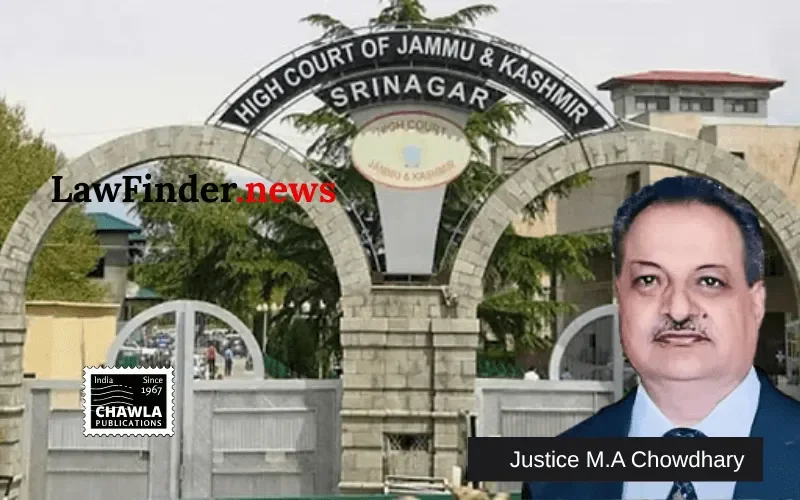
In a significant judgment delivered on October 5, 2026, the Jammu & Kashmir and Ladakh High Court addressed the long-pending issue concerning the regularization and service benefits of contractual and daily-wage employees at the Indira Gandhi National Open University (IGNOU) Regional Centre, Srinagar. The judgment, rendered by Mr. M. A. Chowdhary, J., consolidated three connected writ petitions filed by contractual employees seeking regularization, continuation of service, and parity of benefits with regular employees.
The petitioners, engaged on a contractual or daily-wage basis since as early as 2008, claimed entitlement to be regularized as Group C/Group D employees against the posts they have been serving. They also sought relief against the practice of artificial breaks in service every 89 days and demanded equal pay and other service benefits as provided to regular employees.
The respondents, representing IGNOU and other related bodies, opposed the petitions, stating that the contractual engagements were temporary, seasonal, and filled without a formal recruitment process, thereby precluding any claim to regularization or parity of benefits. They relied on the Indira Gandhi National Open University (Non-Academic Employees Group A, B & C) Recruitment and Promotion Rules, 2010, to argue that the petitioners were ineligible for regular appointments or promotions under the existing framework.
A pivotal aspect of the judgment was the Court's reliance on an earlier Division Bench judgment dated April 3, 2024 (LPASW No. 91/2016), which had overturned the earlier Writ Court's order that had granted deemed regularization to similarly situated employees. The Division Bench had clarified that a Writ Court cannot assume the role of an employer by declaring contractual employees as regular appointees, as such power lies exclusively with the competent authority-in this case, the Board of Management of IGNOU.
However, the Court emphasized that the petitioners had invested considerable service time and had an expectation of quasi-permanent employment due to repeated renewals of their contracts and the permanent establishment mode of the IGNOU Regional Centre. The Court directed the Board of Management of IGNOU to consider the question of regularization of these long-serving contractual employees through a reasoned decision, keeping in mind the relevant policies and practices.
Until such consideration and decision are made, the Court ordered that the petitioners must continue in their employment and not be replaced by fresh daily wagers, contractual employees, or outsourced manpower. The Regional Director of IGNOU's Srinagar Regional Centre was also directed to forward detailed cases of these petitioners, including their length of service, to the Board of Management within one month.
The Court's decision balances the legal position that regularization is an administrative prerogative with the equitable consideration of the service continuity and contribution of the petitioners. It provides a clear procedural framework for the resolution of the issue while protecting the employment rights of the petitioners in the interim.
Bottom Line:
Service law - Contractual/daily-wage employees of IGNOU Regional Centre, Srinagar seeking regularization, continuation and parity of benefits - Single Judge held that issue stood covered by earlier Division Bench judgment in LPASW No. 91/2016 - Though writ court cannot itself declare such employees regularized, their cases are required to be considered by IGNOU Board of Management for regularization in terms of Division Bench directions - Till such consideration, they are to continue in engagement and not be replaced by fresh daily wagers/contractual employees or manpower agency staff.
Statutory provision(s):
Indira Gandhi National Open University (Non-Academic Employees Group A, B & C) Recruitment and Promotional Rules, 2010; Article 39(d) of the Constitution of India (Directive Principles on Equal Pay for Equal Work).