Court says interest claim on delayed dues arose from a fresh cause of action, not barred by res judicata, but miscellaneous application was not the proper route
The Supreme Court has held that a bank employee’s claim for interest on delayed payment of salary and service benefits was not barred by constructive res judicata, since the right to seek interest arose only after prolonged litigation and delayed disbursal of dues. At the same time, the Court ruled that such substantive relief could not be sought through a miscellaneous application in a writ petition that had already attained finality.
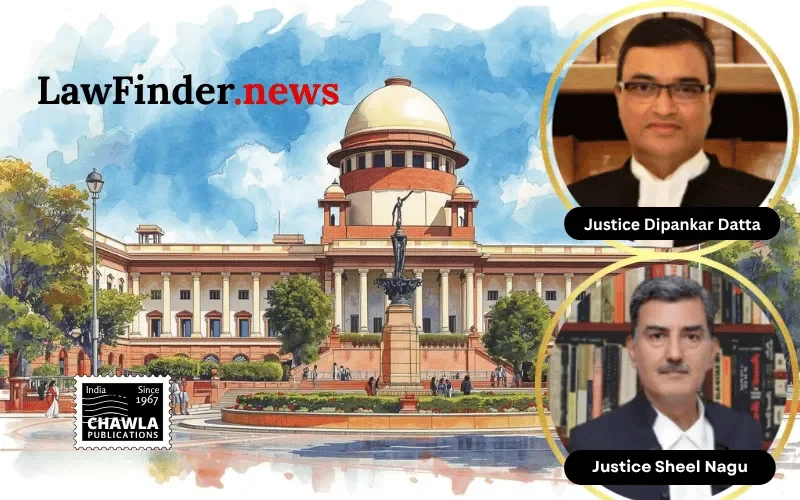
A Bench of Justice Dipankar Datta and Justice Sheel Nagu delivered the verdict in an appeal filed by Ashok Kumar, a former Central Bank of India employee who had been fighting litigation for decades after being suspended in 1978 over allegations of defalcation. Though he was acquitted in the criminal case and later succeeded in having departmental proceedings quashed by the Punjab and Haryana High Court in 2007, the payment of his service dues was delayed until December 2011.
Kumar later sought interest at 18% per annum on the delayed salary and arrears, but the High Court rejected his claim. He first filed a fresh writ petition in 2015, which was dismissed, and then, in 2024, filed a miscellaneous application in the long-closed earlier writ petition seeking the same relief. The High Court dismissed the application, holding that he had not claimed interest in the original proceedings and could not now use a miscellaneous application to modify a final judgment.
The Supreme Court agreed that the miscellaneous application was not maintainable. It said such applications are limited to ancillary matters like correction of clerical errors, clarification of ambiguity, or extension of time, and cannot be used to raise a fresh substantive claim. The Court also held that the claim for interest did not arise from the same cause of action as the original writ petition challenging disciplinary action. Instead, it arose later due to the delay in concluding litigation and releasing monetary benefits.
Referring to earlier precedents, the Court explained that constructive res judicata applies only to claims that could and ought to have been raised when the first proceeding was filed. Since Kumar could not have claimed interest in 1991, when he first approached the High Court, the bar did not apply.
However, the Court noted that Kumar had been wrongfully kept out of service for a long period and had spent years pursuing legal remedies. Taking a compassionate view, and invoking its powers under Article 142 of the Constitution, the Supreme Court directed the Central Bank of India to pay an additional lump sum of Rs 5 lakh to Kumar in full and final settlement of his dues.
The Court observed that while the procedural route chosen by Kumar was incorrect, the equities of the case justified relief. The amount is to be paid within two months of production of the judgment before the bank’s competent authority.
Statutory provision(s): Section 11 Explanation IV, Order II Rule 2 CPC, Section 151 CPC, Article 142 of the Constitution of India, Sections 409, 420, 465, 468, 471, 120B IPC
Ashok Kumar v. Central Bank of India, (SC) : Law Finder Doc id # 3162344