Court says Kalpataru Cold Storage’s financial statements acknowledged debt, making UV Asset Reconstruction Company’s Section 7 plea timely; matter sent back to NCLT on default issue.
The Supreme Court has ruled that entries in a corporate debtor’s balance sheets can amount to a valid acknowledgment of debt under Section 18 of the Limitation Act, thereby extending limitation for filing insolvency proceedings under Section 7 of the Insolvency and Bankruptcy Code (IBC).
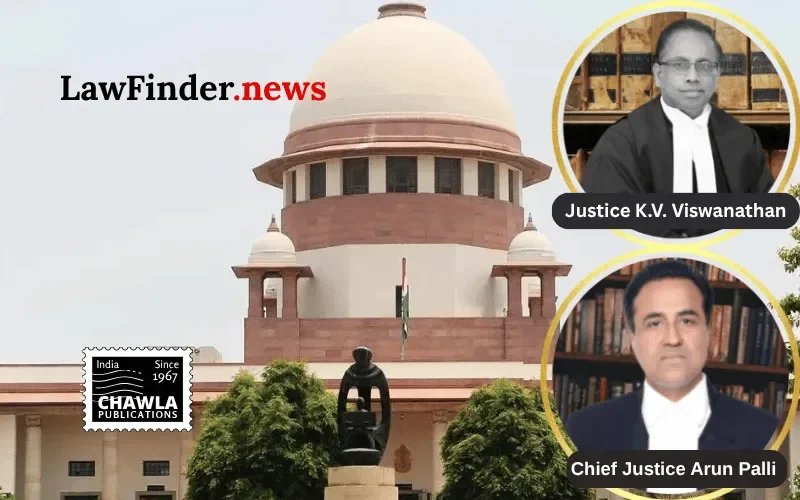
A Bench of Justices K. V. Viswanathan and Arun Palli set aside the National Company Law Appellate Tribunal’s order that had dismissed UV Asset Reconstruction Company Ltd.’s insolvency application as time-barred. The Court held that the balance sheets of Kalpataru Cold Storage Private Limited for financial years 2015-16, 2016-17 and 2017-18 clearly reflected long-term borrowings and liability toward the bank, amounting to acknowledgment of debt.
The dispute arose from a loan sanctioned by United Bank of India in 2013. The account was declared a non-performing asset on 31 March 2014, and the first default was said to have occurred on 31 December 2013. UV Asset Reconstruction Company, which later became the assignee of the debt, filed a Section 7 application before the NCLT on 26 October 2018. While the NCLT admitted the petition, the NCLAT reversed that decision, holding that the claim was barred by limitation.
The Supreme Court disagreed. It observed that the balance sheets showed long-term borrowings and included notes referring to the bank loan, the SARFAESI notice, and the NPA declaration. The Court said these documents could not be read in a “pedantic” manner and must be assessed in context. It also noted that the notes appended to the accounts did not negate the acknowledgment of liability; in fact, one note expressly referred to the company’s accounts being declared NPA due to defaults in repayment.
Relying on earlier rulings including Dena Bank v. C. Shivakumar Reddy and Asset Reconstruction Co. (India) Ltd. v. Bishal Jaiswal, the Court reaffirmed that balance sheet entries may constitute acknowledgment if they show a subsisting jural relationship and liability. It held that the Section 7 application filed in 2018 was within limitation.
However, the Bench clarified that limitation was not the only issue. Since the question of “default” under Section 7(5) had not been examined on merits by the adjudicating authority, the Court remitted the matter back to the NCLT for consideration of that issue alone. All other questions, including limitation, were said to be concluded by the Supreme Court’s ruling.
Bottom Line:
A spouse in possession of properties handed over as part of an interim maintenance arrangement for sustenance cannot be compelled to surrender such possession as a condition for receiving maintenance, especially when the income from such properties is not adequately established.
Statutory provision(s): Section 7 of the Insolvency and Bankruptcy Code, 2016, Section 18 of the Limitation Act, 1963, Section 7(5) of the Insolvency and Bankruptcy Code, 2016, Section 238A of the Insolvency and Bankruptcy Code, 2016
UV Asset Reconstruction Company Ltd. v. Gautam Sinha, (SC) : Law Finder Doc id # 3275064