Division Bench calls crime “rarest of rare”, cites DNA evidence, breach of trust, and extreme brutality; victim compensation raised to Rs. 15 lakh
The Calcutta High Court has upheld the death sentence awarded to Ashok Singh for the rape and murder of a five-year-old girl in Hooghly, holding that the case falls within the “rarest of rare” category because of the extreme brutality of the crime, the victim’s tender age, and the convict’s abuse of a position of trust.
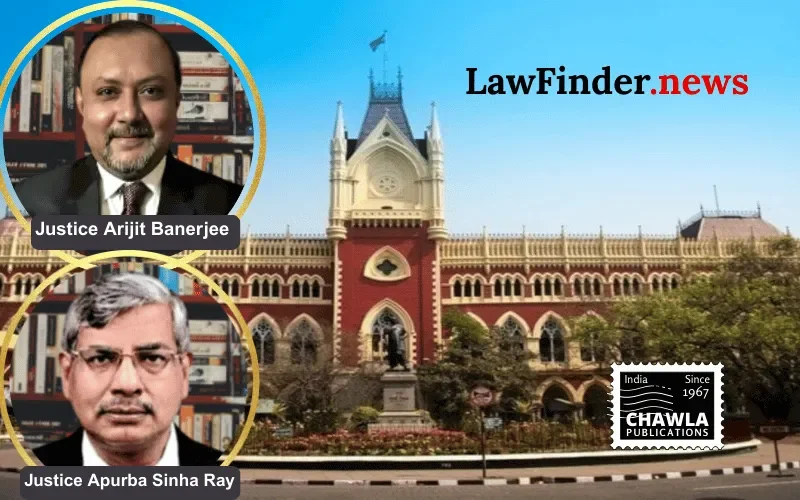
A Division Bench of Justice Arijit Banerjee and Justice Apurba Sinha Ray delivered the judgment on November 17, 2026, while deciding a death reference filed by the State of West Bengal and the convict’s appeal against his conviction and sentence passed by the Exclusive POCSO Court, Chinsurah.
According to the prosecution, the victim, who lived in the same locality as the convict, went missing on the evening of November 24, 2024. Her parents and neighbours searched for her and eventually entered the convict’s house, where they found the child lying unconscious on a floor bedding, naked and bleeding from her private parts. She was taken to hospital and declared dead.
The trial court had convicted Singh under Sections 65(2), 64(2)(1), 66 and 103(1) of the Bharatiya Nyaya Sanhita, 2023, and Section 6(1) of the Protection of Children from Sexual Offences Act, 2012. He was sentenced to imprisonment for the remainder of his natural life for rape under Section 64(2)(1) BNS, and to death for the offences of murder, causing death in the course of sexual assault, and aggravated penetrative sexual assault.
Before the High Court, the defence argued that the case rested entirely on circumstantial evidence and that the chain of circumstances was incomplete. It questioned the reliability of the “last seen” evidence and contended that the death sentence was unsustainable because the trial court had failed to properly consider mitigating factors and the possibility of reform.
Rejecting these submissions, the High Court found that the prosecution had established an unbroken chain of circumstances. The Bench relied heavily on forensic evidence showing that the convict’s DNA was found in swabs taken from the victim’s labia and perineum, as well as on other seized materials. The post-mortem evidence showed recent forceful penetration of the vagina and anus, along with fatal intracranial haemorrhage caused by the child’s head being banged against a wall or floor. The court held that the manner of death was homicidal.
The Bench also accepted the prosecution’s case that the victim was last seen with the convict and noted that her body was recovered from his house soon thereafter. Since the convict failed to explain how the child came to be found in his room in that condition, the court invoked the presumption under Section 106 of the Indian Evidence Act, 1872.
In a strongly worded judgment, the court said the convict lured the child to his house by offering chocolates, exploited the trust of a child who addressed him as “jethu”, sexually assaulted her with barbaric violence, and then killed her to silence the “best witness” to the crime. The Bench described the offence as marked by “extreme depravity”, “barbaric mentality”, and “inhuman attitude”.
On sentencing, the High Court undertook both the “crime test” and the “criminal test” laid down in death penalty jurisprudence beginning with Bachan Singh v. State of Punjab. It found no mitigating factors in Singh’s favour. Psychiatric and psychological evaluations showed no mental illness or impairment. The court also referred to the probation report, which described him as a drunkard and noted troubling aspects of his social conduct. The Bench further observed that he showed no remorse and denied wrongdoing even when confronted with overwhelming scientific evidence.
The judges held that there was no realistic possibility of reform or rehabilitation. They said the aggravating circumstances overwhelmingly outweighed any mitigating considerations and that life imprisonment, even for the remainder of natural life without remission, would be inadequate.
The Bench also placed significant emphasis on victimology, stating that sentencing cannot ignore the trauma suffered by the victim’s family. It noted the mother’s severe emotional breakdown during testimony and said the suffering of the parents had to be factored into the justice process.
While confirming the death sentence, the High Court directed that the convict be informed immediately of his right to appeal to the Supreme Court and of his entitlement to free legal aid. After pronouncement, the Bench stayed the operation of its judgment for three months to enable him to approach the apex court.
In a separate direction, the court expressed displeasure over the delay in payment of victim compensation. Noting that the parents had not yet received the previously sanctioned Rs. 10 lakh, the Bench enhanced the compensation to Rs. 15 lakh and directed the State to pay the amount within two months.
The judgment is significant not only for being one of the early major decisions applying provisions of the Bharatiya Nyaya Sanhita, 2023, in a capital case, but also for reaffirming that courts may uphold the death penalty where the crime involves extreme brutality against a very young child, breach of trust, and no discernible scope for reformation.
Bottom Line:
Death sentence upheld for the rape and murder of a 5-year-old girl under Sections 65(2), 64(2)(1), 66, and 103(1) of the Bharatiya Nyaya Sanhita, 2023, and Section 6(1) of the POCSO Act, 2012, as the case qualified as "rarest of rare" due to the extreme depravity and brutality of the crime.
Statutory provision(s): Sections 65(2), 64(2)(1), 66, 103(1), 163(1) of the Bharatiya Nyaya Sanhita, 2023, Section 6(1), Section 29, Section 30 of the Protection of Children from Sexual Offences Act, 2012, Section 106 of the Indian Evidence Act, 1872, Section 27 of the Indian Evidence Act, 1872, Section 354(3), Section 372 proviso, Section 313, Section 164, Section 162, Section 161, Section 43 of the Code of Criminal Procedure, 1973, Sections 351, 393(3), 183 of the Bharatiya Nagarik Suraksha Sanhita, 2023
State of West Bengal v. Ashok Singh, (Calcutta)(DB) : Law Finder Doc id # 3125665