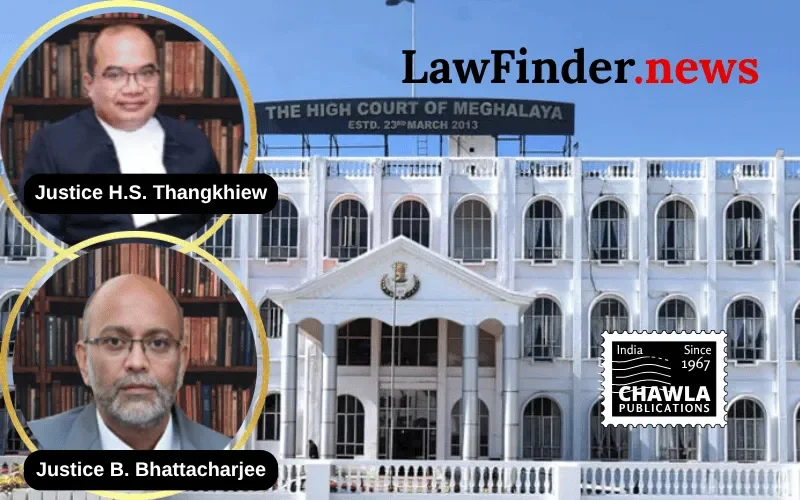
Amendment Act Declared Ultra Vires Due to Non-Compliance with Mandatory Legislative Procedure Under Rule 93 of Assam and Meghalaya Autonomous Districts Rules, 1951
The Meghalaya High Court (Division Bench) delivered a landmark judgment on November 17, 2026, declaring the Khasi Hills Autonomous District (Nomination and Election of the Syiem, Deputy Syiem and Electors of Hima Maharam) (Amendment) Act, 2019 ultra vires. The Court held that the Amendment Act was passed in violation of the mandatory legislative procedure prescribed under Rule 93 of the Assam and Meghalaya Autonomous Districts (Constitution of District Councils) Rules, 1951, and therefore, invalid.
The petition challenging the amendment was filed by Shri Tolentine Wahlang and another against the State of Meghalaya and others. The primary contention was that the Amendment Act, passed by the Khasi Hills Autonomous District Council (KHADC) on July 25, 2019, and assented to by the Governor on September 15, 2023, did not comply with the essential legislative process mandated under the Rules of 1951. Specifically, the Bill was returned by the Governor with a message for reconsideration but was never re-tabled before the District Council for discussion and voting as required by Rule 93.
The original Principal Act of 2006, enacted under Paragraph 3 of the Sixth Schedule of the Indian Constitution, had complied with all legislative formalities, including obtaining the Governor's assent as per the Rules of 1951. However, the Amendment Bill of 2019 sought to introduce significant changes, including the application of the Act to certain administrative matters in Raid Saw Symper and altering the status of the post of Myntri, which traditionally was not equivalent to Rangbah Shnong (Headman). The petitioners argued that the amendment undermined traditional customs and was enacted without proper consultation with the Dorbar Hima (traditional authority).
The Court examined the procedural history in detail. After the Bill was passed in 2019, objections were filed by the Maharam Syiemship and the Law Department recommended omission of certain clauses. The Governor, through the District Council Affairs Department, returned the Bill for reconsideration, which constituted a formal legislative act under Rule 93. However, instead of placing the Bill again before the full Council for discussion and vote, the Executive Committee made amendments and forwarded the Bill directly for the Governor's assent, bypassing the mandatory procedure.
Relying on settled Supreme Court precedents, including Kihoto Hillohan v. Zachillhu and Supreme Court Advocates on Record v. Union of India, the Meghalaya High Court reiterated that courts have jurisdiction to scrutinize legislative enactments for procedural compliance. Non-adherence to prescribed procedures renders the legislation invalid. The Court rejected the respondents' arguments that the Governor had not formally returned the Bill or that the changes were merely clerical.
The Court observed that the legislative power of the District Council, though extensive, must be exercised in accordance with constitutional and statutory procedures. The Executive Committee’s unilateral modification of the Bill without the Council’s approval amounted to an encroachment upon the legislative domain. The failure to place the Bill before the House after it was returned by the Governor was a fatal procedural irregularity.
Consequently, the Meghalaya High Court declared the Khasi Hills Autonomous District (Nomination and Election of the Syiem, Deputy Syiem and Electors of Hima Maharam) (Amendment) Act, 2019 ultra vires and quashed the amendment. The writ petition was allowed, emphasizing the sanctity of legislative procedures and the need to respect established customs and statutory mandates in autonomous district governance.
This decision underscores the judiciary’s role in ensuring that legislatures adhere strictly to procedural requirements, especially in the context of laws affecting tribal and autonomous governance under the Sixth Schedule of the Constitution.
Bottom Line:
Khasi Hills Autonomous District (Nomination and Election of the Syiem, Deputy Syiem and Electors of Hima Maharam) (Amendment) Act, 2019, declared ultra vires due to non-compliance with the mandatory legislative procedure prescribed under Rule 93 of the Assam and Meghalaya Autonomous Districts (Constitution of District Councils) Rules, 1951.
Statutory provision(s): Constitution of India - Sixth Schedule, Assam and Meghalaya Autonomous Districts (Constitution of District Councils) Rules, 1951 - Rule 92(2), Rule 93
Tolentine Wahlang v. State of Meghalaya, (Meghalaya)(DB) : Law Finder Doc Id # 3129797