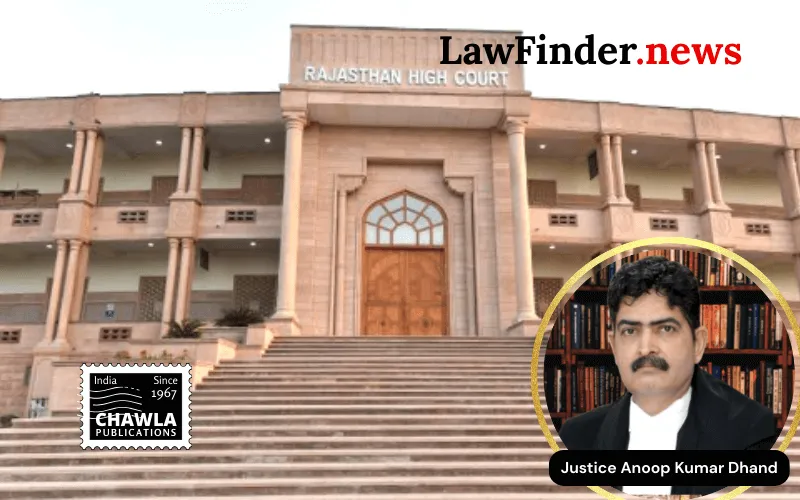
Jodhpur, Aug 21 The Rajasthan High Court has directed authorities to issue passport to a minor for studying abroad despite his application not having the consent of his father, saying denying the boy's constitutional right to travel will cause irreparable harm to his career prospects.
The boy's parents have divorced and he lives with his mother.
The minor had moved the high court through his mother stating that he had applied for the passport but the authorities declined to issue it in absence of the mention of his father on the application.
The passport authorities rejected his application on the ground that it does not have the mandatory consent of his father, said the petitioner's counsel.
Allowing the petition, Justice Anoop Kumar Dhand held that any mechanical approach in denying passport would not only adversely affect the applicant but may cause irreparable harm to his career prospects.
Such mechanical approach by the passport authority cannot be countenanced, the bench said.
"Unless the present of the children is fine and taken care of, their future cannot become bright," the bench said.
Treating the right to travel abroad an integral facet of fundamental right under Article 21 of the Constitution, the court held that children are not property of their parents, rather they are independent individuals under the law.
"Parents are guardians and not owners," it said.
The petitioner's counsel submitted that the parents have been divorced and till date, the father had not prayed for the boy's custody.
However, the respondent counsel objected to the argument stating that the custody of the minor was not clear and hence the consent of both the parents are required.
But turning down the arguments of the respondent counsel, the court held that since the father did not proceed with custody claim and the boy has been residing with his mother since the decree of divorce, the petitioner cannot be declined passport in absence of father's consent, who has no concern whatsoever with the domestic affairs of the petitioner or his mother.
The court noted that the present case is an example of a student being given an opportunity to undertake a study tour.
"The future and career of the petitioner cannot remain dependent upon the wish and will of one parent and he cannot be compelled to approach his father for consent," the court said and directed the passport authority to issue the passport to the petitioner forthwith without any delay.
It further noted the valuable constitutional right of the petitioner cannot be allowed to be prejudiced and taken away merely because consent of his father, who has been divorced by his mother, is not there.
"In present times, travelling abroad cannot be considered to be a fanciful affair but has become an essential requirement of modern life for a child, a student, employee or professional. The need to travel has undergone a monumental change and the right to travel is required to be not only recognised but made more meaningful by the passport authorities," the court further mentioned.
Making a significant observation, the court stated that generally parents worry about what their children would do in future yet they forget that their children are someone today.
Riddham Deora v. Union of India, (Rajasthan) : Law Finder Doc Id # 2965160