Court says compensation for illegal incarceration must be meaningful, not symbolic; directs all High Courts to consider stronger safeguards and digital criminal justice systems.
The Supreme Court of India has sharply enhanced compensation from Rs. 2 lakh to Rs. 30 lakh for a Chhattisgarh man who remained in jail for more than seven years after his acquittal, calling the prolonged detention a grave violation of Article 21 of the Constitution.
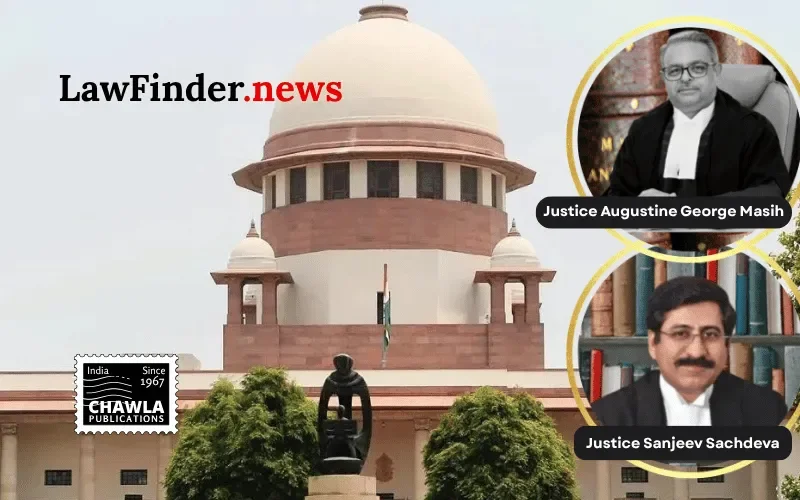
A Bench of Justices Augustine George Masih and Sanjeev Sachdeva held that compensation for wrongful incarceration must do more than offer symbolic relief. It must help the victim rebuild life, restore lost opportunities, and reflect the seriousness of the State’s failure. The Court said the appellant, Devilal Gond, lost the prime years of his youth due to administrative apathy and institutional breakdown.
Gond was arrested in 2012 in a murder case under Section 302 of the Indian Penal Code and was convicted by the trial court in 2013. However, the Chhattisgarh High Court acquitted him on 20 January 2018. Despite the acquittal becoming final, he was not released and continued to remain in custody until 19 May 2025, when the mistake was finally noticed during a records verification exercise. He had remained behind bars for 7 years, 3 months and 29 days after being acquitted.
The State told the Court that the delay was caused by a communication gap between the jail authorities and the legal aid system, and that there was no mala fide intent. The Supreme Court, however, said the explanation reflected complete remissness, lack of coordination, and institutional dysfunction. The Bench observed that the appellant had lost his liberty, livelihood, future prospects, and the best years of his youth due to the State’s failure.
Relying on landmark precedents including Rudul Sah, Bhim Singh, Nilabati Behera, and D.K. Basu, the Court reaffirmed that monetary compensation for violation of fundamental rights is a public law remedy under Articles 32 and 226. It emphasised that sovereign immunity cannot be used as a defence where the State has violated Article 21.
The Court also noted that there is currently no legislative mechanism in India to determine compensation for wrongful incarceration. Referring to the Delhi High Court’s decision in Babloo Chauhan and the Law Commission’s 277th Report, the Bench underlined the need for a structured framework to address miscarriage of justice and wrongful imprisonment.
Taking note of similar safeguards introduced by the Madhya Pradesh High Court after the Supreme Court’s earlier directions in Sohan Singh @ Bablu, the Bench directed all High Courts to consider issuing comparable directions and to examine the feasibility of setting up a Criminal Justice Ecosystem similar to the online system developed in Madhya Pradesh to ensure faster sharing of orders and prison records.
In the present case, the Court ordered that the enhanced compensation of Rs. 30 lakh be paid within four weeks. Of this amount, Rs. 5 lakh is to be transferred directly to the appellant’s savings account, while the balance is to be placed in a fixed deposit with monthly interest credited to him. The District Legal Services Authority will supervise compliance.
The judgment strengthens the Supreme Court’s message that unlawful detention is not a procedural lapse but a constitutional wrong requiring meaningful redress. The Court said compensation must be realistic, restorative, and sufficient to help the victim regain self-sufficiency and dignity.
Statutory provision(s): Article 21 of the Constitution of India, Article 32 of the Constitution of India, Article 226 of the Constitution of India, Section 302 of the Indian Penal Code, Section 437A of the Criminal Procedure Code, Section 429 of the Bharatiya Nagarik Suraksha Sanhita, 2023, Section 436A of the Criminal Procedure Code, Section 357 of the Criminal Procedure Code, Section 357A of the Criminal Procedure Code, Section 358 of the Criminal Procedure Code
Devilal Gond v. State of Chhattisgarh, (SC) : Law Finder Doc id # 3122577