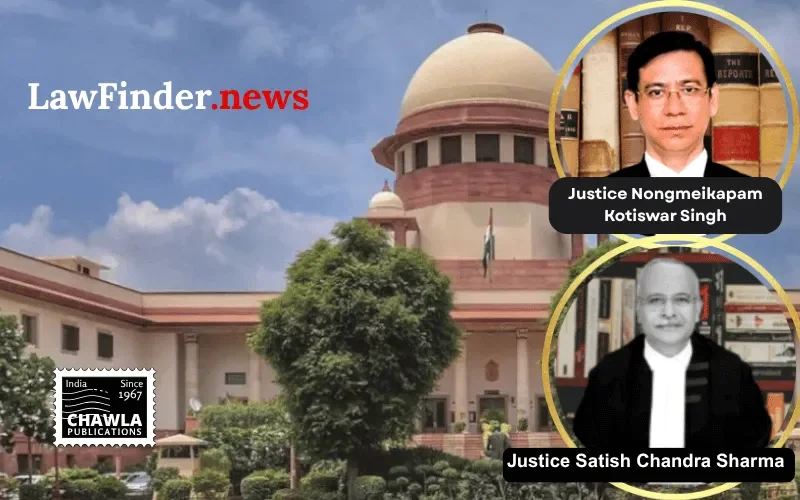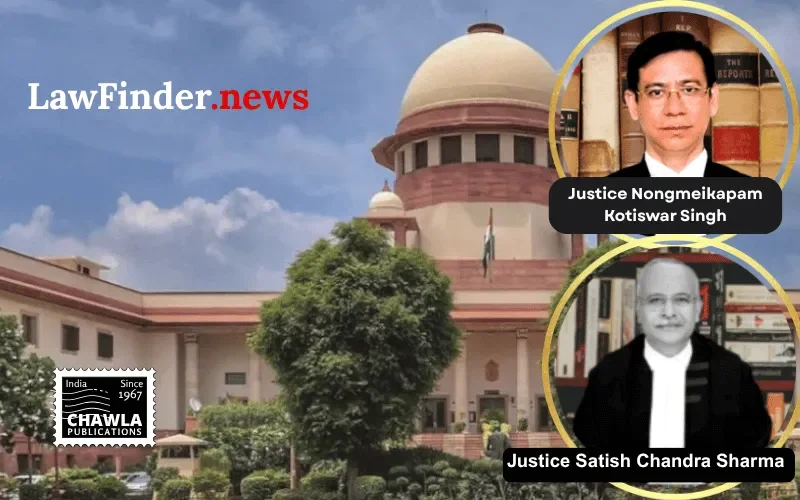
Court rules hearsay FIR, hostile witnesses’ police statements, and doubtful weapon recoveries could not sustain Naresh’s conviction; recommends victim compensation for families of deceased women
The Supreme Court has acquitted Naresh, who had been convicted in the 2011 murders of two women in Haryana’s Bhiwani district, holding that the prosecution failed to prove its case beyond reasonable doubt and that the courts below had relied on material not admissible in law.
A Bench of Justices Satish Chandra Sharma and Nongmeikapam Kotiswar Singh set aside the Punjab and Haryana High Court’s 2013 judgment insofar as it upheld Naresh’s conviction under Sections 302, 449, 297 and 201 of the Indian Penal Code. The High Court had earlier commuted his death sentence to life imprisonment while acquitting co-accused Subhash @ Tinku.
The case arose from the deaths of Suman and Shakuntla, two widows from village Ranila, who were found dead on the night of April 17, 2011. The prosecution alleged that the women were assaulted in the village chowk and their bodies were later dragged into their homes. Naresh was named in the FIR on the basis of a statement by a village panch, Kailash Chander, who admitted he had not witnessed the crime and had only “come to know” that Naresh was responsible.
The Supreme Court found this FIR to be hearsay and said it could not be treated as substantive evidence. The Bench also sharply criticized the reliance placed by the trial court and the High Court on statements recorded by police under Section 161 of the Code of Criminal Procedure. All key private witnesses, including the informant, an alleged eyewitness, and even Suman’s young son Nakul, turned hostile during trial and did not support the prosecution in court.
The top court reiterated that statements made to police during investigation cannot be used as substantive evidence of guilt. Such statements, it said, are barred by Section 162 CrPC except for the limited purpose of contradiction. In this case, the lower courts had wrongly used those police statements to infer both Naresh’s involvement and motive.
The Bench noted that the prosecution’s theory also shifted significantly after the post-mortem. Initially, the case was that the women had been beaten with a danda. But the medical evidence revealed that the fatal injuries were incised, bone-deep wounds caused by a sharp-edged weapon. After that, a second disclosure statement was allegedly recorded from Naresh, leading to the recovery of a gandasi. The Court found this sequence suspicious, especially because the High Court had rejected a similar later disclosure by co-accused Subhash on the same reasoning.
On recoveries, the Supreme Court held that the prosecution had failed to prove the disclosure statements in the manner required by Section 27 of the Indian Evidence Act. The investigating officers did not dep
Naresh v. State of Haryana, (SC) : Law Finder Doc id # 3122573