Court says dissenting financial creditors must be paid in money and in priority; rules overseas assets of Videocon subsidiaries cannot be treated as part of VIL’s insolvency estate
In a significant ruling on the insolvency framework under the Insolvency and Bankruptcy Code, 2016 (IBC), the Supreme Court has upheld the National Company Law Appellate Tribunal’s (NCLAT) decision to remit the approved resolution plan of Twinstar Technologies for Videocon Industries Ltd. (VIL) and 12 group companies back to the Committee of Creditors (CoC) for reconsideration.
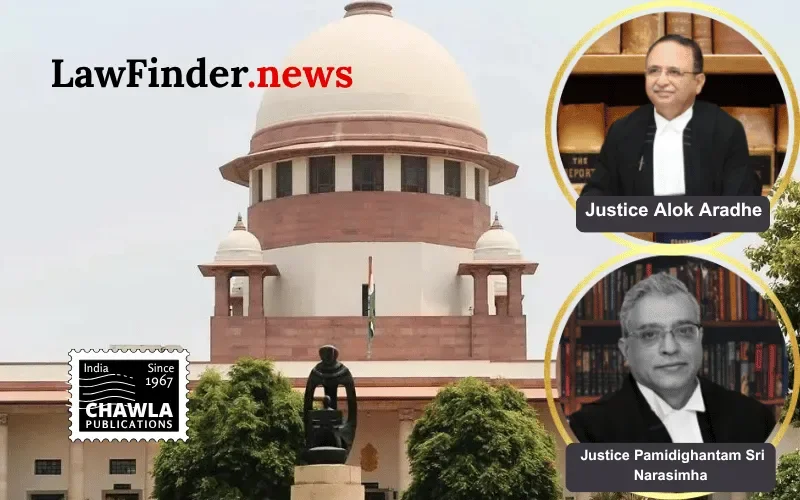
A Bench of Justices Pamidighantam Sri Narasimha and Alok Aradhe, in its judgment dated November 16, 2026, held that the NCLAT was right in sending the plan back instead of rejecting it outright, because the plan failed to comply with mandatory legal requirements relating to dissenting financial creditors.
The case arose from the corporate insolvency resolution process (CIRP) of Videocon Industries and related group entities. Twinstar Technologies, the successful resolution applicant, had challenged the NCLAT’s January 5, 2022 order that set aside approval of its plan and remitted the matter to the CoC. Separate appeals were also filed by former promoter Venugopal Dhoot and others over the exclusion of foreign oil and gas assets from the Videocon insolvency process.
The Supreme Court ruled against Twinstar and dismissed its appeals. The Court held that a resolution plan must provide payment to dissenting financial creditors “in terms of money” and not through instruments such as non-convertible debentures (NCDs) redeemable over several years. It found that the Twinstar plan, though containing a general promise of compliance, did not specifically secure lawful payment to dissenting creditors as required under Section 30(2)(b) of the IBC and Regulation 38(1)(b) of the CIRP Regulations.
The Bench relied on its earlier ruling in Jaypee Kensington and said a dissenting financial creditor cannot be forced to remain tied to the corporate debtor through securities or deferred instruments. It also held that the National Company Law Tribunal (NCLT) could not cure this defect by directing upfront cash payment, because that would amount to modifying the commercial terms of the plan — a power reserved to the CoC.
At the same time, the Court clarified that the NCLAT has the power to remit a defective resolution plan to the CoC where legal non-compliance is found. Such remand, it said, is necessary to preserve the objectives of the IBC, especially value maximisation and avoidance of liquidation. The Court noted that neither the NCLT nor the NCLAT can rewrite a plan, and remand is the proper course where defects are curable.
On the issue of the Competition Commission of India (CCI) approval, however, the Supreme Court disagreed with the NCLAT. It held that Twinstar had obtained CCI approval on December 8, 2020, before the CoC voting concluded on December 11, 2020, and therefore the requirement under Section 31(4) of the IBC stood satisfied.
The Court also rejected Twinstar’s argument that the CoC became functus officio after approving the plan. It held that the CoC continues to exist through the CIRP until the plan is implemented or liquidation is ordered, and may revisit its decision in exceptional situations, particularly where the approved plan is found legally non-compliant and is under challenge in appeal.
In the second set of appeals, the Supreme Court dismissed the promoter’s plea seeking inclusion of Videocon group’s foreign oil and gas assets in Brazil and Indonesia in the CIRP of VIL. The Bench held that these assets were owned by subsidiaries and not by VIL itself, and therefore stood excluded from the insolvency estate by virtue of the Explanation to Section 18 and Section 36(4)(d) of the IBC.
The Court reiterated the settled principle that a holding company and its subsidiaries are separate legal entities, and that a holding company does not own the assets of its subsidiary merely because it controls it. It ruled that the statutory exclusion in the IBC could not be overridden by arguments based on beneficial ownership agreements or lifting of the corporate veil.
The Bench also found that promoter Venugopal Dhoot was estopped from taking a contrary stand, noting that he had earlier sought to keep the offshore assets outside the insolvency process and had acquiesced in their exclusion. Applying the doctrine of approbation and reprobation, the Court said he could not later demand their inclusion to challenge the resolution outcome.
The Court further declined to interfere with the separate CIRP of VOVL, a Videocon subsidiary, and the completed transaction involving Brazilian assets and BPRL under a right of first refusal arrangement. It held that the promoter had no locus to challenge that transaction after the Court had already rejected the claim that the assets belonged to VIL.
Importantly, the judgment lays down broader principles on when the NCLAT may remand an approved resolution plan. The Supreme Court said remand must be based on legal non-compliance, used sparingly, and accompanied by strict timelines so that the insolvency process remains time-bound.
With this ruling, the Supreme Court has reinforced that commercial wisdom of the CoC remains paramount, but only within the bounds of statutory compliance. It also underlined that liquidation is a last resort, and curable defects in a plan should ordinarily be addressed by sending the matter back to the CoC rather than by outright rejection.
Statutory provision(s): Insolvency and Bankruptcy Code, 2016 - Sections 7, 9, 12A, 18, 21, 30(2)(b), 30(3), 30(4), 31(1), 31(2), 31(4), 33(1)(b), 36(4)(d), 53, 60(5), 61(3), 62, 66; Insolvency and Bankruptcy Board of India (Insolvency Resolution Process for Corporate Persons) Regulations, 2016 - Regulation 18(2), Regulation 38(1)(b); Competition Act, 2002 - Sections 5, 6; National Company Law Appellate Tribunal Rules, 2016 - Rule 11; Companies Act, 2013; General Clauses Act, 1897
Twinstar Technologies Limited v. Bank of Maharashtra, (SC) : Law Finder Doc id # 3122571