Bench says State cannot revive an old exclusion through new wording; pre-regularisation service must count for pension, with relief limited to three years’ arrears
The Supreme Court has invalidated two Uttar Pradesh laws that sought to deny pensionary benefits to employees who had served in work-charged, temporary, daily-wage or muster-roll capacities before being regularised. In a significant ruling with wide service-law consequences, the Court held that the Uttar Pradesh Qualifying Service for Pension and Validation Act, 2021, and the Uttar Pradesh Entitlement to Pension and Validation Act, 2025, were unconstitutional insofar as they attempted to retrospectively exclude such earlier service from pension computation.
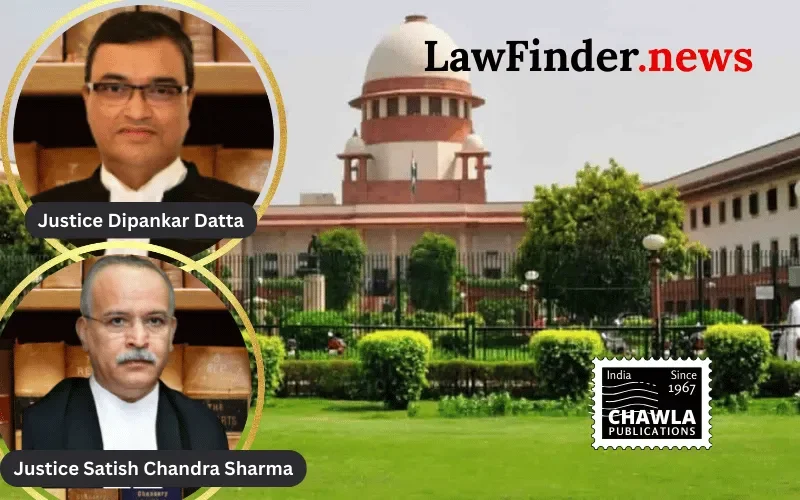
A bench of Justices Dipankar Datta and Satish Chandra Sharma ruled that the State could not simply repackage an exclusion already rejected in the Court’s 2019 decision in Prem Singh v. State of Uttar Pradesh. The judges said the earlier judgment had read down Rule 3(8) of the Uttar Pradesh Retirement Benefits Rules, 1961, and held that service rendered in a work-charged establishment must count as qualifying service for pension after regularisation. The later validating laws, the Court found, did not remove the defect identified in Prem Singh; instead, they merely reintroduced the same exclusion in new statutory language.
The Court explained that validating legislation is permissible only when the legislature has the power to act on the subject and actually cures the legal defect pointed out by the Court. A law cannot merely declare a judicial decision ineffective while leaving the underlying problem untouched. On that test, the 2021 and 2025 enactments failed. The Court said the new expressions “qualifying service” and “substantive appointee” were used to preserve the same denial of pension that Prem Singh had already disapproved.
The bench also held that the impugned laws violated Articles 14 and 21 of the Constitution. It found no rational basis for denying pension to employees who had worked continuously, been accepted by the State, and later been regularised into the regular service stream. Once regularisation takes place, the Court said, the “birthmark” of the initial appointment is obliterated. The State cannot later revive that distinction to deprive employees of retiral benefits.
The judgment further emphasised that Prem Singh was not a mere abstract declaration of law. It had resulted in operative directions requiring payment of pensionary benefits, and those directions had attained finality after the review petition was dismissed and the curative petition was withdrawn. The Court held that such a final mandamus cannot be neutralised by legislation unless the very basis of the judgment is lawfully removed.
Allowing the writ petitions and dismissing the State’s appeals, the Supreme Court declared both validation laws ultra vires. It directed that eligible employees’ claims be considered in light of Prem Singh, and ordered the competent authorities to decide such claims within six months. However, following the approach in Prem Singh, the Court restricted monetary arrears to the three years preceding institution of proceedings. In cases where legal heirs of deceased employees claim benefits, the three-year restriction will not apply if the employee had died before the 2019 Prem Singh judgment, subject to proof of entitlement.
On contempt, the Court noted the State’s repeated delays in implementing Prem Singh. While it refrained from making final findings of wilful disobedience in the absence of complete compliance records, it granted the State one last six-month opportunity to make full payment to the concerned contempt petitioners. If payment is not made within that period, simple interest at 9% per annum will apply.
Statutory provision(s): Rule 3(8), Uttar Pradesh Retirement Benefits Rules, 1961, Regulation 370, Civil Service Regulations, Articles 14 and 21, Uttar Pradesh Qualifying Service for Pension and Validation Act, 2021, Uttar Pradesh Entitlement to Pension and Validation Act, 2025